Eye Pads for Eyelash Extension Private Label: MOQ 5000 China
October 17, 2026
Skincraftlab
B2B Skincare Manufacturing Expert
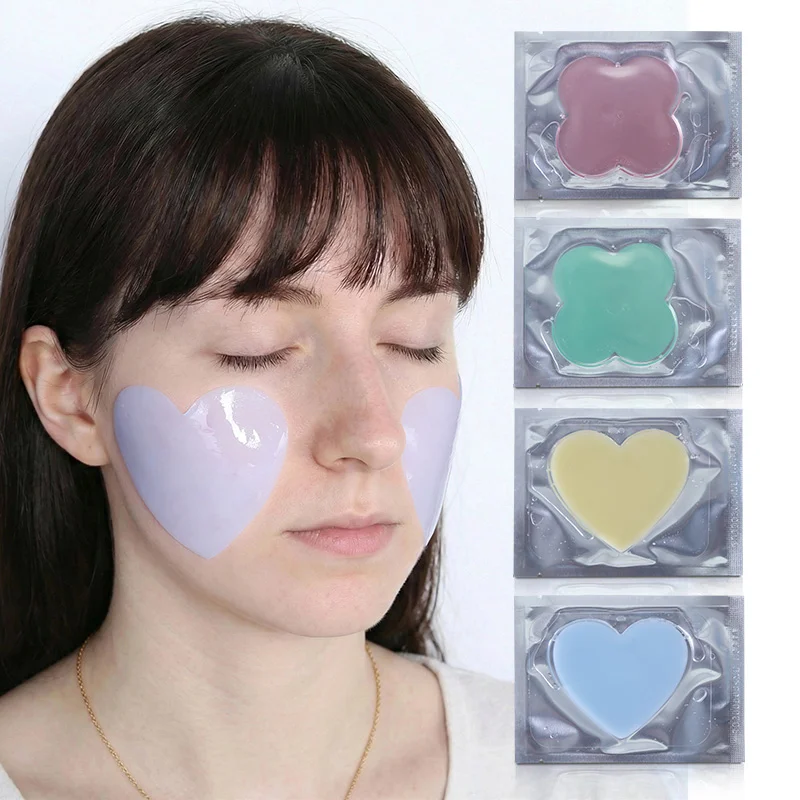
What Is This Guide About?
What MOQ 5000 eye pads actually buys from a Chinese OEM — print setup, capacity math, and how to verify hydrocolloid and hydrogel lines before you sign.
Category
eye pads for eyelash extension private label custom printing MOQ 5000 China
Audience
Brand owners, procurement, R&D
Updated
October 2026
For a private-label eye pad run with custom printing, China OEMs typically quote MOQ 5,000 pairs per SKU, with print plate/screen setup at USD 120–350 one-time and unit FOB pricing of USD 0.09–0.22 per pair at that volume. Lead time runs 28–35 days from artwork approval. The MOQ is driven by the printing step, not the gel or hydrocolloid line — which is why 5,000 is negotiable and 2,000 usually is not.
That paragraph is the short answer. The rest of this piece is what happens after the quote lands in your inbox — because the number on the quote sheet and the number a factory can actually deliver in month four are two different things (yes, that's the part buyers skip and regret later).
Key stats: eye pad private-label runs at MOQ 5,000

Figures below are drawn from our 2026 production log at the Zhongshan facility and from quotes we've seen buyers bring in from competing factories.
| Line item | Typical range | Notes |
|---|---|---|
| MOQ per SKU (custom print) | 5,000 pairs | 2,000–3,000 possible with stock print film |
| Print setup (screen/plate) | USD 120–350 | One-time, per design |
| FOB unit price at 5,000 | USD 0.09–0.22 / pair | Depends on gel weight and pouch type |
| Sample lead time | 7–12 days | Includes print proof |
| Production lead time | 28–35 days | From artwork sign-off |
| Carton configuration | 100–200 pairs/carton | Varies by pouch format |
| Standard shelf life | 24–36 months | Unopened, ambient storage |
Why MOQ 5,000 exists — and why it isn't the gel
We've run hundreds of private-label eye pad batches. The MOQ almost never comes from the hydrogel or hydrocolloid cutting line — those run continuously and a 5,000-pair order is a short afternoon. The MOQ comes from three upstream steps: printing, pouch sealing, and carton labelling.
Custom printing on the pad backing film or the pouch is a setup-heavy process. A screen or plate has to be burned, registered, and colour-matched before the first sellable unit comes off the line. Below about 5,000 pairs, the amortized setup cost pushes unit price up 30–50% — which is why factories counter-offer at 5,000 instead of saying no.
Here's the practical implication: if you want a lower entry MOQ, drop the custom print before you drop the pad quality. Buy stock-printed film at 2,000–3,000 pairs, validate sell-through, then move to custom print at 5,000 on reorder. We've watched brands burn USD 4,000 on a print design for a SKU that never reordered. Start with the cheaper mistake.
The three eye pad formats buyers conflate
A procurement conversation goes sideways fast when "eye pad" means three different products to two people. Pin down the format before you ask for a price:
| Format | Core material | Typical use | FOB at 5,000 |
|---|---|---|---|
| Lash-extension gel pad | Hydrogel (water-based, cooling) | Under-eye during lash application | USD 0.09–0.14 |
| Hydrocolloid eye patch | Hydrocolloid (CMC + adhesive) | Wound-adjacent, acne-adjacent, peeling | USD 0.14–0.22 |
| Cosmetic under-eye mask | Hydrogel with actives (e.g. caffeine) | Retail skincare SKU | USD 0.18–0.28 |
The lash-extension gel pad is the volume driver — it's a consumable inside the salon service, not a retail SKU. Buyers sourcing this format are usually lash-supply distributors, not beauty brands, and their spec sheet is short: does it hold under the eye for 90 minutes without slipping, and does it leave residue.
If you're building a retail eye patch SKU instead, look at our hydrogel sheet mask and eye patch line — same cutting equipment, different formulation and pouch.
Custom printing: what actually needs to be on the artwork
One pattern we keep seeing: buyers send a logo and expect the factory to figure out the rest. That adds a week of back-and-forth (and one round of misprinted samples). Send a print-ready file with these locked:
- Bleed and safe area (usually 2 mm on a 25×60 mm pad)
- Pantone references — not RGB hex codes
- Which surface: pad backing vs. outer pouch vs. both
- Barcode and batch-code zone reserved
- Regulatory text zone if selling into a regulated market
Custom printing on the pouch also carries a regulatory consequence. If the pouch lists ingredients, warnings, and a country of origin, that artwork needs to be reviewed against the destination market before the plate is cut. A plate change costs USD 120–350. A shipment rejected at the border costs six figures. We've seen both; only one is worth planning for.
Verifying a factory's real capacity before you sign an annual contract
The eye pad MOQ question is easy. The capacity question is where contracts die — and it's the same question buyers ask about hydrocolloid acne patches and hydrogel sheet masks, just at different scale.
Take the acne patch claim you'll hear everywhere: hydrocolloid acne patch OEM capacity 1 million units monthly China factory. That number is real and common — but ask what "unit" means. A single 12 mm patch and a 40 mm patch are not the same unit, and a factory claiming 1 million/month in "units" may be counting patches while you're counting retail pouches (usually 24–36 patches per pouch). 1 million patches/month is roughly 28,000–42,000 retail pouches. That's a different business.
Same trap on sheet masks: hydrogel sheet mask OEM factory capacity 5 million units annual contract China is a standard annual-contract figure for a mid-size line — but confirm whether that's mask units or cartons, and whether the 5 million is committed capacity or theoretical line speed. A factory running at theoretical speed with no buffer will miss your Q4.
Three verification steps that cut through the number games:
- Ask for the last 6 months of actual output, by line, with batch numbers. A factory that can't produce this is guessing.
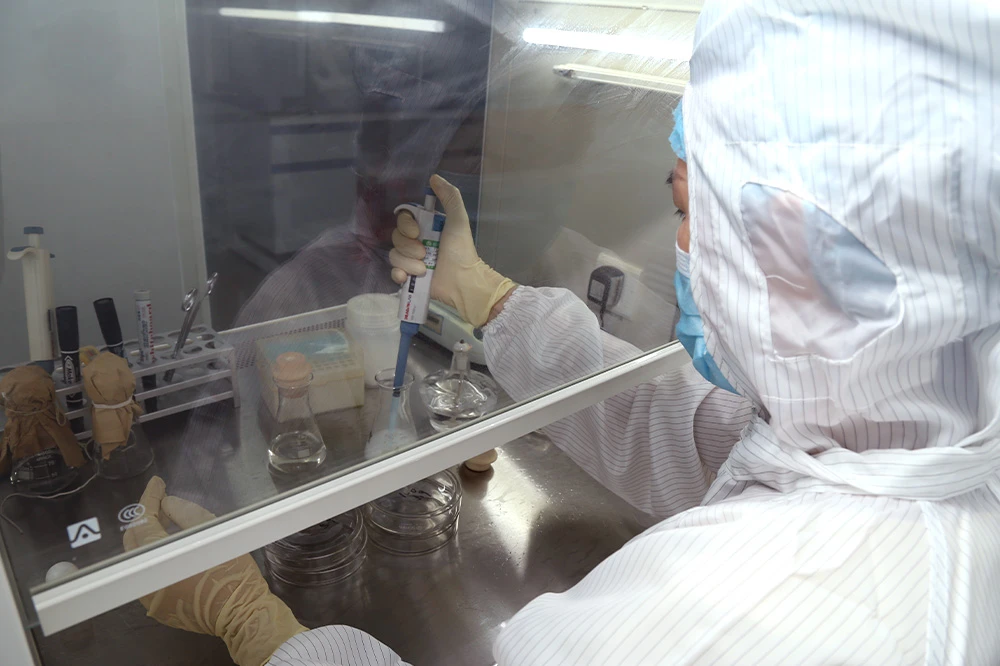
- Request a factory audit or accept a third-party one (BSCI, SGS, Intertek). ISO 22716 and GMPC certificates are the floor, not the ceiling.
- Place a trial order at 20–30% of contracted volume and time it. If the trial runs late, the annual contract will run later.
Reading a quote sheet without getting fooled
| Line on quote | What it usually hides |
|---|---|
| "FOB Shenzhen" | Origin port matters — inland factories add trucking |
| "MOQ 5,000" | Often per SKU per print design, not per order |
| "Lead time 30 days" | Usually from deposit, not from PO |
| "Free sample" | Freight is billed; print proof is not free |
| "ISO 22716 certified" | Ask which site — group certificates are common |
None of these are dishonest. They're shorthand, and shorthand assumes you already know the industry. Most first-time buyers don't (fair — nobody's born knowing FOB terms).
What Skincraftlab does on eye pad runs
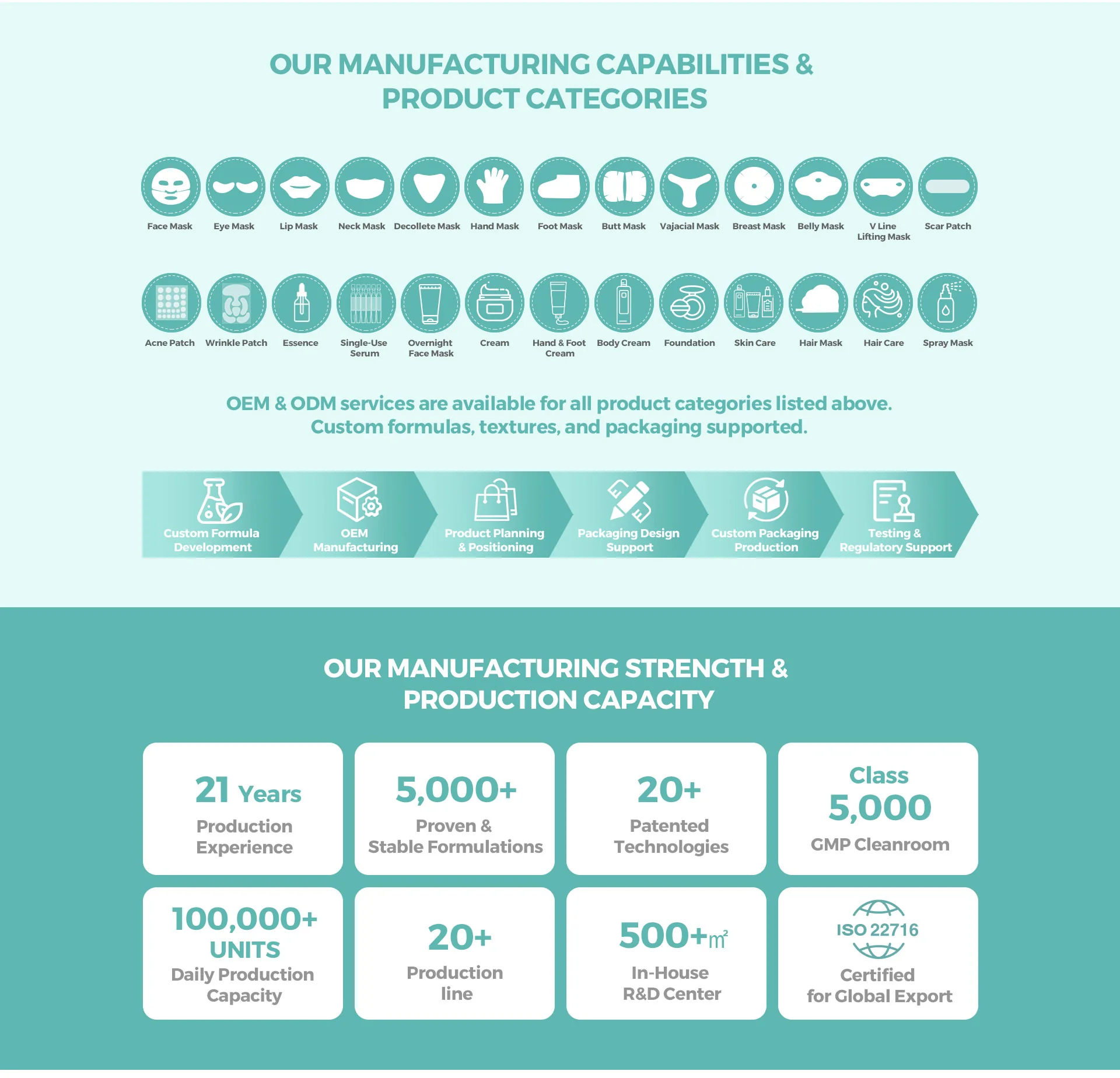
We manufacture eye pads, hydrocolloid patches, and hydrogel masks at our GMP-certified facility in Zhongshan, under ISO 22716 and GMPC. Eye pad private-label runs with custom printing start at MOQ 5,000 pairs; stock-print entry runs at 2,000–3,000. Hydrocolloid acne patch lines run to 1 million units/month and hydrogel sheet mask lines support annual contracts in the 5 million unit range. Sampling is 7–12 days, production 28–35 days from artwork sign-off. If your spec is already drafted, send it; if it isn't, we'll send a spec template first.
FAQ
Q: What is the real MOQ for eye pads for eyelash extension private label custom printing from a China factory?
MOQ 5,000 pairs per SKU is the standard for custom-printed eye pads from a Chinese OEM. The floor is set by print setup cost, not by the gel or hydrocolloid line. If you accept stock-printed film, MOQ drops to 2,000–3,000 pairs — a common first-order compromise before moving to custom print on reorder.
Q: How do I verify a hydrocolloid acne patch OEM capacity claim of 1 million units monthly from a China factory?
Ask the factory to define "unit" first — patch or retail pouch. A 1 million patch/month line equals roughly 28,000–42,000 pouches at 24–36 patches per pouch. Then request six months of output records by line and batch number, accept a third-party audit (BSCI, SGS), and place a trial order at 20–30% of contracted volume before signing.
Q: What does a hydrogel sheet mask OEM factory capacity of 5 million units annual contract actually commit a China factory to?
It usually means 5 million mask units per year across the mask line — but confirm whether that's committed capacity or theoretical line speed, and whether it accounts for packaging and QC bottlenecks. A factory with no buffer at theoretical speed will miss Q4. Request monthly delivery schedules in the contract, not annual totals.
Q: How long does a private-label eye pad order take from artwork approval to shipment?
Our 2026 production log shows 28–35 days from artwork sign-off to shipment for MOQ 5,000 eye pad runs, plus 7–12 days for sampling and print proof. Add 3–5 days for regulatory artwork review if selling into a regulated market, and 5–7 days for ocean freight booking.
Q: What certifications should I require from a China eye pad OEM?
At minimum ISO 22716 (cosmetic GMP) and GMPC, with the certificate matching the actual production site — group certificates covering multiple facilities are common and worth checking. For EU sales, the CPSR is the brand owner's responsibility but the factory must supply the Safety Assessment data. BSCI or equivalent social compliance is standard for distributors selling into EU and North American retail chains.
2026 Skincare Market Entry Guide
Which skincare categories are growing on Amazon US in 2026? Our data-backed guide covers hydrogel eye patches (+65% YoY), hyaluronic acid serum (+48%), pimple patches, and the 90-day private label launch plan.
No spam, ever. Unsubscribe anytime.
What Are the Key Facts Before You Request a Quote?
Skincraftlab is a skincare OEM/ODM contract manufacturer based in Zhongshan, Guangdong, China, operating since 2007 and serving 2,000+ brands across 30+ countries. Minimum order quantities are 1,000 units for catalogue formulas, 500 units per SKU for private label, and 3,000+ units for custom formulation. Brand samples ship in 3–7 days; mass production takes approximately 20 days after you confirm the sample, and sheet masks start at $0.08–$0.35 per piece. Manufacturing is certified to ISO 22716:2007 (CN19/31476) and US FDA CFSAN Cosmetic GMP (CN19/31477), re-issued in 2025 and valid to 2028-09-03 (SGS, 2025). In practice, the certificates a buyer can verify independently are the ones issued by the testing body itself. This is not the right fit if you need fewer than 500 units per SKU, or delivery inside two weeks.
| Topic | Details |
|---|---|
| Category | eye pads for eyelash extension private label custom printing MOQ 5000 China |
| Minimum order | 1,000 units standard; 500 per SKU private label; 3,000+ custom |
| Samples & production | Brand samples 3–7 days; production approx. 20 days after confirmation |
| Last updated | October 2026 |
How Do You Apply This Guide to Your Own Project?
- 1Step 1: match the format to your unit cost — for example, sheet masks run $0.08–$0.35 per piece at 1,000 units, while serums run $1.50–$5.00 per bottle.
- 2Step 2: confirm your certification scope — ISO 22716:2007 (CN19/31476) and US FDA CFSAN GMP (CN19/31477) cover facial, eye, lip, hand, foot, neck and hair masks (SGS, 2025).
- 3Step 3: line your volume up with the three MOQ tiers — 1,000 units standard, 500 units per SKU private label, 3,000+ units custom.
- 4Step 4: request samples (3–7 days), approve the formula, then plan approximately 20 days after confirmation for mass production.
- 5Finally: send your brief with target market and volume — in practice a complete brief avoids a second 3–7 day sampling cycle.
Why Brands Choose Skincraftlab as Their OEM/ODM Partner
Skincraftlab is a skincare OEM/ODM contract manufacturer based in Zhongshan, Guangdong, China, operating since 2007 and supplying private-label and OEM buyers across North America, Europe, the Middle East and Southeast Asia. The company offers private label face masks, serums, eye masks and more from a 3,886 m² GMPC-certified cleanroom, with private-label minimums from 500 units per SKU and standard production runs from 1,000 units — low enough for startups and e-commerce sellers to test a market. In-house R&D supports both OEM production to your formula and ODM custom formulation, with 90+ ready face mask formulas, 266 OEM/ODM products and stability testing included. Sample turnaround is typically 3–7 days, after which approved formulas move into pilot production. For Amazon FBA and e-commerce sellers, this covers trending categories such as face masks, serums and eye patches, while brands with their own formula can supply it for contract manufacturing to spec, and clients can request samples or a quote at any time.
Frequently Asked Questions
What is the real MOQ for eye pads for eyelash extension private label custom printing from a China factory?
How do I verify a hydrocolloid acne patch OEM capacity claim of 1 million units monthly from a China factory?
What does a hydrogel sheet mask OEM factory capacity of 5 million units annual contract actually commit a China factory to?
How long does a private-label eye pad order take from artwork approval to shipment?
What certifications should I require from a China eye pad OEM?
Related Posts
OEM Eye Pads Eyelash Extension: MOQ 5000 FOB Price China
Real MOQ 5,000, FOB $0.11–$0.26/pair, 28–35 day lead times, and custom printing specs for OEM eye pads under lash extensions. Factory data, not quotes.
Chat SLA for OEM Skincare Inquiries in China: Pimple Patch Sourcing
Real chat SLA benchmarks for OEM skincare inquiries in China, plus hydrocolloid vs hydrogel pimple patch material specs and per-unit cost gaps for 2026 buyers.

Chat SLA & Hydrocolloid Pimple Patch Sourcing Specs
Concrete SLA benchmarks for OEM skincare chat inquiries from China, plus hydrocolloid vs hydrogel pimple patch sourcing specs and manufacturing cost gaps.
Related Products

Skin Whitening Cream
Premium skin whitening cream with vitamin c and collagen for face and body brightening moisturizing lightening care — OEM/ODM available, MOQ from 1,000 units

Transparent Silicone Scar Gel Sheet for Effective Silicone Scar Sheets for Body Care
Premium logo transparent silicone scar gel sheet for effective silicone scar sheets for body care — OEM/ODM available, MOQ from 1,000 units

Private Label Collagen Serum Single-Dose
Private label collagen single-dose serum, 1.2 ml vials, 10 or 30 pcs per box, 1,000 boxes MOQ

Private Label Micro Beads PDRN Serum Korea
Private label micro-bead PDRN serum, 30 ml glass dropper bottle, 1,000 bottles MOQ