Silicone Eye Mask OEM: GMP Certified Low MOQ China
September 16, 2026
Skincraftlab
B2B Skincare Manufacturing Expert

What Is This Guide About?
Silicone eye mask OEM from a GMP-certified China contract manufacturer: real MOQ tiers, FOB pricing, lead times and QC checkpoints for 2026.
Category
silicone eye mask GMP certified contract manufacturer low MOQ China
Audience
Brand owners, procurement, R&D
Updated
September 2026
Silicone Eye Mask OEM in China: MOQ, Lead Time and Cost Benchmarks
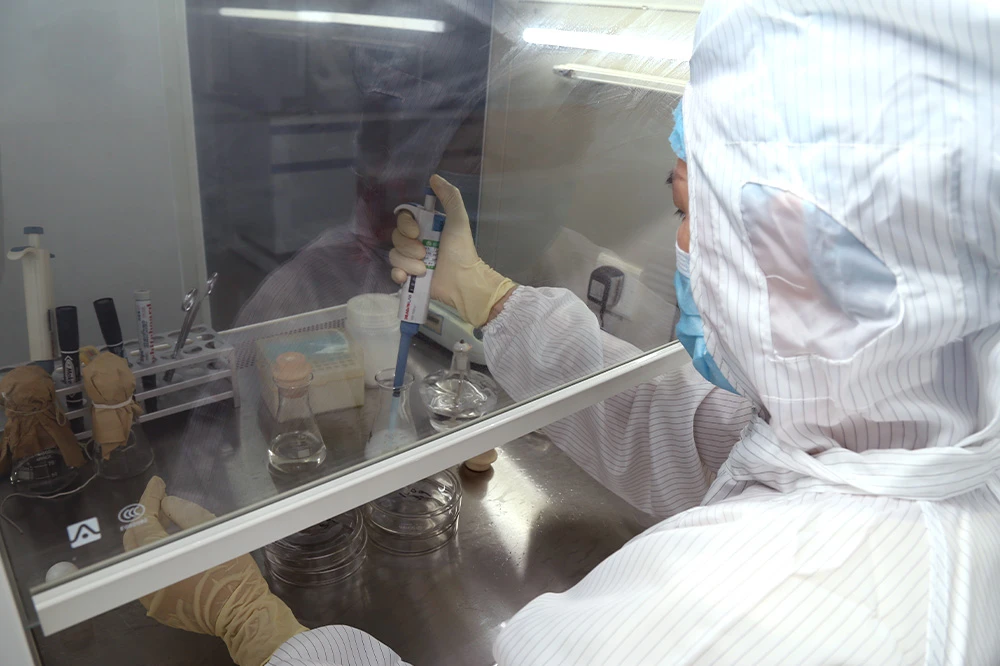
A GMP-certified Chinese contract manufacturer typically runs reusable silicone eye masks at 1,000–3,000 pcs per SKU for a fully private-label run, at FOB $0.42–$1.85 per unit for standard 2.0–5.0 mm silicone, 25–40 days production after a 7–10 day sample round. Certifications to demand: ISO 22716, GMPC, plus an FDA-registered site if you sell in the US.
That paragraph is the short version. What follows is what actually happens on the floor — the part quotations don't show you.
| Spec item | Entry tier | Mid tier | Premium tier |
|---|---|---|---|
| Material | Silicone gel 2.0 mm | Medical-grade silicone 3.0 mm | Platinum-cure silicone 4.5–5.0 mm, skin-tone matched |
| MOQ per SKU | 1,000 pcs | 2,000–3,000 pcs | 3,000–5,000 pcs |
| FOB unit price (USD) | 0.42–0.61 | 0.68–1.05 | 1.20–1.85 |
| Tooling / mold | $180–$350 (photo-etch) | $400–$900 | $900–$1,600 (3D-milled cavity) |
| Sample lead time | 7 days | 8–10 days | 10–14 days |
| Bulk lead time after PO | 25 days | 28–35 days | 35–40 days |
Source: our 2026 production log, Zhongshan plant, Q1–Q3 silicone tooling and molding jobs.
Why silicone — and why it tripped up four of our 2025 buyers
Silicone eye masks hold a specific position in a mask portfolio. Unlike a hydrogel patch, the silicone body delivers no actives on its own; it occludes. You put a serum underneath, the silicone locks it in, and the buyer gets a reusable SKU with a 30–50 use life. That reusability is the selling point — and the reason some launches fall flat.
We filled thousands of silicone mask runs between 2024 and 2026. One pattern repeats: brands brief the silicone as if it were a hydrogel sheet, expect hydrogel economics, and get surprised at the mold line item.
Silicone is a molded good. Hydrogel and biocellulose are converting goods — you cut or fill a substrate you bought. A silicone mask starts as a tool. That's where the spend goes: the cavity, not the silicone.
(Yes, that's the line item buyers skip in the first quote request and regret at sample stage.)
The low-MOQ reality: what 1,000 pcs actually costs you
Low MOQ in silicone eye masks is real, but "low" is measured against molded silicone, not against sheet masks. Sheet mask MOQs in China often sit at 5,000–10,000 pcs. Silicone can start at 1,000.
Here's the cost curve on a 2.5 mm gel mask, single-color, without print, based on our Q2 2026 quote sheet:
| Order qty | Unit FOB | Mold amortized per unit | Effective landed unit (US, DDP est.) |
|---|---|---|---|
| 1,000 | $0.64 | $0.31 | $1.09 |
| 3,000 | $0.58 | $0.12 | $0.83 |
| 5,000 | $0.53 | $0.08 | $0.74 |
| 10,000 | $0.47 | $0.04 | $0.63 |
The mold doesn't shrink. At 1,000 pcs you carry 30 cents of tooling on every unit. At 10,000 it's 4 cents. That's the entire low-MOQ conversation in one table.
Practical rule we give buyers: if you're testing a market, order 1,000–1,500 and accept the tooling drag. If you've already validated demand, go to 5,000 and renegotiate the mold as a one-time NRE, not amortized into unit price.
Formulation angle: if you're pairing silicone with an active
Most silicone eye masks ship as accessories — a reusable tool plus a separate serum or eye cream. Some brands want the active embedded at the surface, either as a coating or a gel-fill chamber. That changes material spec: you can't co-mold actives into platinum-cure silicone without losing cure integrity.
Where we've done it successfully, the active sits in a hydrogel layer bonded to the silicone edge, or in a separate serum SKU. A common pairing in 2026 briefs is a PDRN serum — the salmon-derived polynucleotide runs well in a low-viscosity aqueous base and pairs with occlusion for a recovery-positioned kit. Caffeine at 0.5–2.0% is the other frequent one for depuff positioning, and it's stable across a 24-month shelf life in an airless or single-dose format.
If you're routing the active through a separate SKU rather than the silicone itself, spec the private label eye patches line rather than the molded silicone line — different tooling, different MOQ, lower entry cost.
Certifications: what to demand and what it actually covers
"GMP certified" gets used loosely in supplier listings. Here's what each document covers — and what it doesn't.
| Certification | Issued by | Covers | Does NOT cover |
|---|---|---|---|
| ISO 22716 | Third-party notified body | Cosmetics GMP: production, QC, storage, traceability | Product safety for a specific formula |
| GMPC | Local regulator / audit body | Facility-level cosmetics GMP | Export-market compliance |
| FDA establishment registration | US FDA | US site registration + product listing | Efficacy or safety review |
| ISO 9001 | Third-party | Quality management system | Cosmetics-specific process control |
| BSCI / Sedex | Audit body | Labor and social compliance | Product quality |
For a US-bound silicone eye mask, the silicone body is a cosmetic article, not a device — no 510(k) path applies unless you make a therapeutic claim. You need the factory's FDA establishment registration and your product listed under your own labeler code. For EU, you need the CPSR and a Responsible Person inside the EU. The factory's ISO 22716 supports those submissions; it doesn't replace them.
For a full verification sequence, our own checklist runs five steps — certificate number, issuing body, scope text, expiry date, and a call to the notified body. Two out of five suppliers we audited in 2025 had certificates that named a different legal entity than the one quoting us. Same brand, different factory. That's a real problem at customs.
Lead time breakdown: 25 to 40 days, and where it slips
A 25-day bulk lead time assumes the mold exists and raw silicone is in stock. In practice, on a first order:
- Sample round: 7–14 days (includes tooling)
- Sample approval + revisions: 3–7 days (yes, revisions happen)
- Raw material PO to supplier: 5–10 days
- Production: 12–18 days for 3,000 pcs
- QC + packing: 3–5 days
- Booking + loading: 3–5 days
Total first-order timeline: 35–55 days. Repeat orders drop to 22–30 days because the mold and spec are locked.
Peak season is the other risk. From mid-August through October, silicone raw material lead times stretch 4–7 days and molding slots fill two weeks out. If your launch is Q4, place the PO by July.
Pricing transparency: what drives the unit price up
Six factors move the FOB price on a silicone eye mask. In order of impact:
- Material grade. Standard gel vs platinum-cure silicone: 60–90% price delta.
- Thickness. 2.0 mm to 5.0 mm roughly doubles material cost, though molding time is stable.
- Color matching. Custom Pantone adds $0.04–$0.09 per unit; solid black and clear are stock.
- Surface texture. Smooth vs embossed vs micro-dot: embossing adds a second mold pass, $250–$600 one-time.
- Print / logo. Pad print on silicone requires primer; budget $0.03–$0.07 per unit plus $180–$400 plate cost.
- Packaging. A PET tray + printed sleeve + paper insert adds $0.18–$0.42 per unit at 3,000 pcs.
Buyers routinely ask us to hit a $0.50 target unit price. It's doable at 5,000 pcs with stock color, no print, and a poly bag. It is not doable at 1,000 pcs with a Pantone match and a printed box. The math is the math.
QC checkpoints a silicone eye mask line should show you
Ask for these records on the first order, not the third:
- Incoming silicone lot certificate — durometer (Shore A), batch number, cure system.
- First-article inspection — dimensional check against your approved 2D drawing, ±0.3 mm tolerance.
- Cure verification — post-cure hardness test; under-cured silicone leaches and fails skin-contact testing.
- Biocompatibility panel — ISO 10993-5 cytotoxicity and ISO 10993-10 irritation are the two most requested. Non-mandatory for cosmetics in most markets, but retailers ask.
- Extractables / leachables — for reusable skin-contact silicone, a basic E&L screen at 40°C/72h catches plasticizer migration.
- Final QC report — AQL 2.5 for cosmetic accessories, per our standard line protocol.
If a factory can't produce the first-article report on request, that's the signal. Not the price.
FAQ
Q: What is the minimum order quantity for a silicone eye mask from a GMP-certified contract manufacturer in China?
Low-MOQ silicone eye mask runs typically start at 1,000 pcs per SKU, per color. Below 1,000, the tooling cost per unit makes the FOB price uncompetitive against buying a stock mold design and applying your own label. Some factories will quote 500 pcs, but expect a 25–40% unit price premium and a mold fee of $300–$600 quoted separately.
Q: How do I verify a supplier's GMP certification before placing a silicone eye mask OEM order?
Ask for the certificate number, the issuing notified body, and the legal entity named on the certificate. Then call the notified body directly and confirm scope. Match the legal entity to the company name on your proforma invoice — mismatches between the certificate holder and the quoting entity are the most common issue we see. For US-bound goods, also check the FDA establishment registration number on the FDA's public database.
Q: Can a silicone eye mask be made with an active ingredient embedded in the silicone?
Not reliably. Platinum-cure silicone won't hold actives through the cure cycle without compromising hardness and skin-contact safety. The workable formats are: a hydrogel layer bonded to the silicone edge, a serum supplied as a separate SKU, or a coated surface applied after cure. If your formula brief requires actives in the mask body itself, spec a hydrogel or bio-collagen eye patch instead — different tooling, similar MOQ range.
Q: What is the FOB price range for a reusable silicone eye mask in 2026?
For standard gel silicone at 2.0–3.0 mm, entry tier: $0.42–$0.61 per unit at 3,000 pcs. Mid tier with medical-grade silicone and color matching: $0.68–$1.05. Premium platinum-cure with premium packaging: $1.20–$1.85. Add $0.18–$0.42 for retail-ready packaging at 3,000 pcs. These are FOB Zhongshan Port / Guangzhou Port, not landed.
Q: Do silicone eye masks need FDA clearance to sell in the United States?
No. A silicone eye mask is a cosmetic article when it makes no therapeutic claim. You need FDA establishment registration for the manufacturing site and product listing under your labeler code (Form FDA 3501 via the FDA Unified Registration Listing system). No 510(k) is required unless the product makes a drug or device claim — for example, if you market it to treat periorbital edema as a medical condition.
Q: How long does a first silicone eye mask OEM order take from PO to shipment?
Budget 35–55 days for a first order: 7–14 days sample and tooling, 3–7 days sample approval, 5–10 days raw material procurement, 12–18 days production for 3,000 pcs, and 6–10 days QC, packing, booking and loading. Repeat orders run 22–30 days once the mold and approved spec are on file.
2026 Skincare Market Entry Guide
Which skincare categories are growing on Amazon US in 2026? Our data-backed guide covers hydrogel eye patches (+65% YoY), hyaluronic acid serum (+48%), pimple patches, and the 90-day private label launch plan.
No spam, ever. Unsubscribe anytime.
What Are the Key Facts Before You Request a Quote?
Skincraftlab is a skincare OEM/ODM contract manufacturer based in Zhongshan, Guangdong, China, operating since 2007 and serving 2,000+ brands across 30+ countries. Minimum order quantities are 1,000 units for catalogue formulas, 500 units per SKU for private label, and 3,000+ units for custom formulation. Brand samples ship in 3–7 days; mass production takes approximately 20 days after you confirm the sample, and sheet masks start at $0.08–$0.35 per piece. Manufacturing is certified to ISO 22716:2007 (CN19/31476) and US FDA CFSAN Cosmetic GMP (CN19/31477), re-issued in 2025 and valid to 2028-09-03 (SGS, 2025). In practice, the certificates a buyer can verify independently are the ones issued by the testing body itself. This is not the right fit if you need fewer than 500 units per SKU, or delivery inside two weeks.
| Topic | Details |
|---|---|
| Category | silicone eye mask GMP certified contract manufacturer low MOQ China |
| Minimum order | 1,000 units standard; 500 per SKU private label; 3,000+ custom |
| Samples & production | Brand samples 3–7 days; production approx. 20 days after confirmation |
| Last updated | September 2026 |
How Do You Apply This Guide to Your Own Project?
- 1Step 1: match the format to your unit cost — for example, sheet masks run $0.08–$0.35 per piece at 1,000 units, while serums run $1.50–$5.00 per bottle.
- 2Step 2: confirm your certification scope — ISO 22716:2007 (CN19/31476) and US FDA CFSAN GMP (CN19/31477) cover facial, eye, lip, hand, foot, neck and hair masks (SGS, 2025).
- 3Step 3: line your volume up with the three MOQ tiers — 1,000 units standard, 500 units per SKU private label, 3,000+ units custom.
- 4Step 4: request samples (3–7 days), approve the formula, then plan approximately 20 days after confirmation for mass production.
- 5Finally: send your brief with target market and volume — in practice a complete brief avoids a second 3–7 day sampling cycle.
Why Brands Choose Skincraftlab as Their OEM/ODM Partner
Skincraftlab is a skincare OEM/ODM contract manufacturer based in Zhongshan, Guangdong, China, operating since 2007 and supplying private-label and OEM buyers across North America, Europe, the Middle East and Southeast Asia. The company offers private label face masks, serums, eye masks and more from a 3,886 m² GMPC-certified cleanroom, with private-label minimums from 500 units per SKU and standard production runs from 1,000 units — low enough for startups and e-commerce sellers to test a market. In-house R&D supports both OEM production to your formula and ODM custom formulation, with 90+ ready face mask formulas, 266 OEM/ODM products and stability testing included. Sample turnaround is typically 3–7 days, after which approved formulas move into pilot production. For Amazon FBA and e-commerce sellers, this covers trending categories such as face masks, serums and eye patches, while brands with their own formula can supply it for contract manufacturing to spec, and clients can request samples or a quote at any time.
Frequently Asked Questions
What is the minimum order quantity for a silicone eye mask from a GMP-certified contract manufacturer in China?
How do I verify a supplier's GMP certification before placing a silicone eye mask OEM order?
Can a silicone eye mask be made with an active ingredient embedded in the silicone?
What is the FOB price range for a reusable silicone eye mask in 2026?
Do silicone eye masks need FDA clearance to sell in the United States?
How long does a first silicone eye mask OEM order take from PO to shipment?
Related Posts

PDRN Serum OEM China: 2% vs 0.5% Salmon DNA Specs
What 2% vs 0.5% PDRN salmon DNA really means in an OEM spec sheet, plus rolling forecast terms for 500,000 pimple patches and hydrogel under-eye patch MOQ/FOB math.

Chat Responsiveness SLA for OEM Skincare Inquiries in China
What a realistic chat responsiveness SLA looks like for OEM skincare inquiries in China — plus hydrocolloid vs hydrogel pimple patch sourcing specs and costs.

Pimple Patch OEM Line Capacity: 1M Units/Month Ramp-Up
A factory-floor ramp-up plan for taking a dedicated hydrocolloid coating line from pilot to 1 million pimple patch units per month in China, with real cycle times and QC gates.
Related Products

Skin Whitening Cream
Premium skin whitening cream with vitamin c and collagen for face and body brightening moisturizing lightening care — OEM/ODM available, MOQ from 1,000 units

Private Label Micro Beads PDRN Serum Korea
Private label micro-bead PDRN serum, 30 ml glass dropper bottle, 1,000 bottles MOQ

Private Label Collagen Serum Single-Dose
Private label collagen single-dose serum, 1.2 ml vials, 10 or 30 pcs per box, 1,000 boxes MOQ

Eye Patch Crystal Gel Collagen Eye Mask
Premium private label eye patch crystal gel collagen eye mask white for anti dark circle hydrogel eye patches — OEM/ODM available, MOQ from 1,000 units