PDRN Serum OEM China: 2% vs 0.5% Salmon DNA Specs
October 11, 2026
Skincraftlab
B2B Skincare Manufacturing Expert

What Is This Guide About?
What 2% vs 0.5% PDRN salmon DNA really means in an OEM spec sheet, plus rolling forecast terms for 500,000 pimple patches and hydrogel under-eye patch MOQ/FOB math.
Category
PDRN serum salmon DNA content percentage specification OEM China 2% vs 0.5%
Audience
Brand owners, procurement, R&D
Updated
October 2026
For a PDRN serum salmon DNA content percentage specification OEM China 2% vs 0.5% decision, the number on the COA must be tied to a defined assay method, not a label claim. In practice: 0.5% PDRN (as supplied, ~90% polynucleotide purity) is the standard commercial fill; 2% is a premium claim that requires a supplier willing to run HPLC-UV or agarose gel quantification per lot, and it roughly triples raw-material cost per 30ml bottle. Without the assay, both numbers are marketing.
That is the short version. Here is how the spec actually gets written, priced, and defended in an audit.
| Spec item | 0.5% PDRN fill | 2% PDRN fill |
|---|---|---|
| PDRN raw input per 30ml | 0.15 g | 0.60 g |
| Raw material cost (Q1 2026, China) | USD 0.22–0.38/bottle | USD 0.88–1.52/bottle |
| Assay method required | UV-Vis + supplier COA | HPLC-UV or gel densitometry per lot |
| Typical MOQ (private label) | 1,000 units | 3,000 units |
| FOB unit price, 30ml airless | USD 2.10–2.90 | USD 3.40–4.80 |
| Lead time, first run | 25–30 days | 38–45 days |
| Claim risk (EU/BR) | Low | Medium–High without assay file |
What "2% PDRN" means on a Chinese OEM spec sheet

We filled a private-label PDRN run in Zhongshan across Q3–Q4 2025 — 4,800 units of a 30ml airless serum for a Korean-diaspora brand selling into Canada. The client asked for "2% salmon DNA" because a competitor listed it. We asked one question: 2% of what?
Three answers exist in the market, and only one survives a buyer's audit.
2% w/w of PDRN raw material as supplied. This is the honest reading. You buy PDRN powder or liquid concentrate, you weigh it, it goes in at 2% of the finished batch mass. If the raw material is 90% polynucleotide purity, your finished product carries roughly 1.8% active.
2% of a pre-diluted stock solution. Suppliers sell "PDRN 5% solution" — meaning the concentrate is already diluted in water and preservative. If you add 2% of that stock, your real PDRN load is 0.1%. This is the most common source of angry buyer emails six months post-launch.
2% as a label story. No assay, no incoming COA, just a number the marketing team liked. We decline these.
(The middle one is the trap. It is also the cheapest to quote, which is why it wins so many RFQs.)
When we spec PDRN, the document names: raw material grade, polynucleotide purity by supplier COA, input percentage w/w, and carrier system. For reference on how we document actives generally, our PDRN polynucleotide specification page lists the grades we buy against.
Why 0.5% is the commercial default and 2% is a premium tier
Across Q1 2026 orders at our facility, 0.5% PDRN fills accounted for roughly 7 of every 10 PDRN serum units we produced. The reason is not formulation difficulty — it is cost tolerance at retail.
A 0.5% PDRN serum at 30ml carries about USD 0.30 of active. A 2% fill carries USD 0.90–1.50, depending on whether you buy salmon-derived or fermentation-derived polynucleotide. Multiply that by your run size and add the assay cost — HPLC-UV per lot in China runs USD 120–180 per sample, and a reasonable QC plan is one assay per batch plus one retained sample per quarter.
Here is the part buyers underestimate: at 2%, the serum base has to change. Polynucleotides at that load thicken the aqueous phase and can throw off preservative efficacy. We typically reformulate the humectant system and re-run PET (preservative efficacy test) — that is 21 days and roughly USD 400–600 per challenge test. So the real delta between 0.5% and 2% is not 3x raw material. It is raw material plus testing plus a reformulation cycle.
If your retail price ceiling is under USD 30 and your COGS target is 18%, 2% does not pencil out unless you are selling into Korea or Japan where PDRN carries a visible price premium.
How PDRN is quantified (and what a real COA shows)
A legitimate PDRN COA from a Chinese supplier should carry four data points. If any are missing, treat the percentage as unverified.
| COA field | What it proves | Red flag if absent |
|---|---|---|
| Polynucleotide content (%) | Actual active load | Blank or "conforms" |
| Assay method | UV-Vis (260nm) or HPLC-UV | No method named |
| Molecular weight range | PDRN vs high-MW DNA | Single number, no range |
| Source declaration | Salmon (Oncorhynchus) testis/skin vs fermentation | "Marine origin" generic |
| Microbial + endotoxin | Injectable-adjacent grade, if claimed | Missing endotoxin for "pharma grade" |
UV-Vis at 260nm is the workhorse method — cheap, fast, and adequate for lot-to-lot consistency. HPLC-UV is tighter and what we run for 2% fills. Gel electrophoresis shows the fragment size distribution, which matters if your claim language touches "low molecular weight" or "fragment size."
One more thing. PDRN absorbs humidity and is heat-sensitive. We store incoming PDRN at 2–8°C and use it within 90 days of opening. If your OEM keeps it on an open warehouse shelf, your 2% is 1.6% by month three.
For buyers building a full serum line, our vitamin C serum private label page shows the same spec discipline applied to an antioxidant active — useful as a formatting template for your own PDRN spec sheet.
Setting a rolling forecast: the 500,000-unit pimple patch commitment
When a buyer tells us they need a private label pimple patch annual forecast 500000 units rolling forecast commitment China OEM, the conversation moves fast from "what is your MOQ" to "what do you actually commit to in writing."
A rolling forecast works like this in our contracts. The buyer provides a 12-month non-binding forecast (say 500,000 units), a 6-month binding window, and a 90-day firm order. We hold hydrocolloid raw material and finished pouches against the 6-month window. If the buyer cancels inside the 90-day firm window, they pay for material already converted.
What we need from the buyer to price a 500,000-unit program accurately:
Unit geometry — 12mm round, 10mm x 30mm strip, or multi-size pack. Tooling changes with geometry.
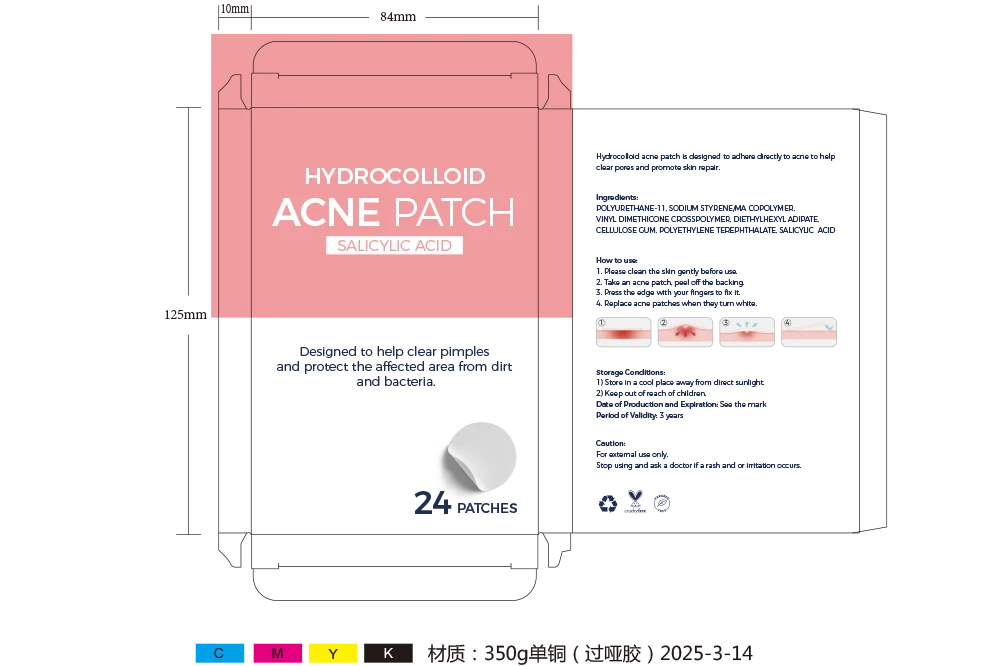
Packaging format — single pouched, 24-count box, or 36-count resealable. Count per box drives pouch film and carton cost more than the patch itself.
Hydrocolloid spec — CMC-based standard versus a higher-absorbency blend with petrolatum and polyisobutylene. The second runs 22–30% more on raw material.
Actives, if any — salicylic acid, tea tree, niacinamide at the adhesive face. Each active adds stability testing.
At 500,000 units annually split into four runs of 125,000, our FOB price band for a 12mm hydrocolloid patch, single pouched with printed backing, landed in the USD 0.035–0.055 range per patch depending on volume tier and packaging. Below 100,000 units annual, that number climbs toward USD 0.07–0.09.
The rolling forecast is what gets you the lower band. A one-time 500,000 order and a 12-month 500,000 forecast are not priced the same — the second one lets us buy hydrocolloid sheet in master rolls and schedule coating runs on a fixed cadence.
(Yes, this is why we ask for the forecast before quoting. A quote without a forecast is a guess with a decimal point.)
Hydrogel under-eye patch OEM factory MOQ and FOB pricing
The hydrogel under-eye patch OEM factory MOQ 3000 units question comes up constantly, and 3,000 is a real tier — not a floor, but the point where custom die-cutting becomes economical.
Our under-eye hydrogel tiers at a 1,000-unit MOQ for stock tooling, but custom shape, custom pouch, custom carton, and a custom serum base (PDRN, caffeine, hyaluronic acid, or peptide blends) push the practical MOQ to 3,000 pairs. At 3,000 pairs we run a dedicated coating batch, cure, die-cut, pouch, and carton without sharing the line with another SKU.
FOB price ranges for hydrogel under-eye patches, 2026 quotes, Guangzhou/Shenzhen port:
| Configuration | MOQ | FOB per pair |
|---|---|---|
| Stock shape, stock serum, bulk packed | 1,000 | USD 0.12–0.18 |
| Custom shape, stock serum, single pouch | 3,000 | USD 0.18–0.26 |
| Custom shape, custom serum, printed pouch + carton | 3,000 | USD 0.24–0.36 |
| Custom shape, custom serum, PDRN or peptide fill | 5,000 | USD 0.32–0.48 |
Three cost drivers matter more than people expect. Pouch film with high barrier (foil laminate) adds USD 0.02–0.04 per pair. Custom carton with spot UV and inner tray adds another USD 0.05–0.10. And a serum with PDRN at 0.5% adds roughly USD 0.03 per pair; at 2%, roughly USD 0.10.
Our hydrogel sheet mask and eye patch production page walks through our line setup if you want to see the spec format before you RFQ.
Two operational notes from running these lines. First, hydrogel under-eye patches have a shelf-life clock that starts at cure, not at ship — build 30 days into your launch plan. Second, if you are also forecasting patches through the same supplier, bundle the award. We schedule hydrogel and hydrocolloid on adjacent lines, and a bundled 500,000-patch plus 3,000-pair program gets better material pricing than either alone.
FAQ
Q: What is the difference between 2% and 0.5% PDRN serum salmon DNA content percentage specification OEM China 2% vs 0.5% in a real spec sheet?
0.5% means the PDRN raw material is weighed at 0.5% of the finished batch mass, and at typical 90% polynucleotide purity that delivers roughly 0.45% active. 2% means 2% w/w raw material input, roughly 1.8% active. The critical clause is whether the percentage refers to raw material as supplied or to a pre-diluted stock solution — a "2% of a 5% stock" spec actually delivers 0.1% PDRN. Always require the raw material grade, purity, input percentage, and assay method on the COA.
Q: Can a Chinese OEM support a private label pimple patch annual forecast 500000 units rolling forecast commitment?
Yes, and it is a standard structure. We use a 12-month non-binding forecast, a 6-month binding material window, and a 90-day firm order. At 500,000 units annually split across four runs, FOB pricing for a 12mm hydrocolloid patch single-pouched lands in the USD 0.035–0.055 range. Below 100,000 units annually the price is closer to USD 0.07–0.09 because raw material is bought in smaller increments and line changeovers are more frequent.
Q: What is the hydrogel under-eye patch OEM factory MOQ and FOB price in China?
Stock shape with stock serum starts at 1,000 units, FOB USD 0.12–0.18 per pair. Custom shape pushes the MOQ to 3,000 pairs, FOB USD 0.18–0.26. Custom shape plus custom serum plus printed pouch and carton lands at USD 0.24–0.36. Add a PDRN or peptide serum and 5,000-pair MOQ, and the band is USD 0.32–0.48 per pair. Barrier foil pouch and custom carton are the two biggest packaging cost levers.
Q: How is PDRN quantified in a serum, and which assay should I require?
UV-Vis at 260nm is standard for routine lot consistency. For a 2% claim, require HPLC-UV or agarose gel densitometry per lot, because UV-Vis can be confounded by other UV-absorbing excipients at high active loads. Expect USD 120–180 per HPLC sample in China, plus a retained sample program quarterly. Without a named assay method, the percentage on the label is a marketing figure.
Q: How long is the lead time for a 2% PDRN serum versus a 0.5% fill?
First-run lead time for 0.5% is 25–30 days from approved formula and artwork. For 2%, plan 38–45 days because the higher active load usually forces a preservative system review and a 21-day PET challenge test. Reorder lead time on either tier is 18–24 days once the formulation and packaging are locked and material is in-house.
Q: Do I need a separate stability test if I change PDRN from 0.5% to 2%?
Yes. A change in active load above 20% of the original input triggers a re-test under most quality systems, and moving from 0.5% to 2% is a 4x change. Plan for accelerated stability at 40°C/75% RH for 3 months plus a preservative efficacy test. Budget USD 900–1,500 and 8–12 weeks before you commit to a launch date.
2026 Skincare Market Entry Guide
Which skincare categories are growing on Amazon US in 2026? Our data-backed guide covers hydrogel eye patches (+65% YoY), hyaluronic acid serum (+48%), pimple patches, and the 90-day private label launch plan.
No spam, ever. Unsubscribe anytime.
What Are the Key Facts Before You Request a Quote?
Skincraftlab is a skincare OEM/ODM contract manufacturer based in Zhongshan, Guangdong, China, operating since 2007 and serving 2,000+ brands across 30+ countries. Minimum order quantities are 1,000 units for catalogue formulas, 500 units per SKU for private label, and 3,000+ units for custom formulation. Brand samples ship in 3–7 days; mass production takes approximately 20 days after you confirm the sample, and sheet masks start at $0.08–$0.35 per piece. Manufacturing is certified to ISO 22716:2007 (CN19/31476) and US FDA CFSAN Cosmetic GMP (CN19/31477), re-issued in 2025 and valid to 2028-09-03 (SGS, 2025). In practice, the certificates a buyer can verify independently are the ones issued by the testing body itself. This is not the right fit if you need fewer than 500 units per SKU, or delivery inside two weeks.
| Topic | Details |
|---|---|
| Category | PDRN serum salmon DNA content percentage specification OEM China 2% vs 0.5% |
| Minimum order | 1,000 units standard; 500 per SKU private label; 3,000+ custom |
| Samples & production | Brand samples 3–7 days; production approx. 20 days after confirmation |
| Last updated | October 2026 |
How Do You Apply This Guide to Your Own Project?
- 1Step 1: match the format to your unit cost — for example, sheet masks run $0.08–$0.35 per piece at 1,000 units, while serums run $1.50–$5.00 per bottle.
- 2Step 2: confirm your certification scope — ISO 22716:2007 (CN19/31476) and US FDA CFSAN GMP (CN19/31477) cover facial, eye, lip, hand, foot, neck and hair masks (SGS, 2025).
- 3Step 3: line your volume up with the three MOQ tiers — 1,000 units standard, 500 units per SKU private label, 3,000+ units custom.
- 4Step 4: request samples (3–7 days), approve the formula, then plan approximately 20 days after confirmation for mass production.
- 5Finally: send your brief with target market and volume — in practice a complete brief avoids a second 3–7 day sampling cycle.
Why Brands Choose Skincraftlab as Their OEM/ODM Partner
Skincraftlab is a skincare OEM/ODM contract manufacturer based in Zhongshan, Guangdong, China, operating since 2007 and supplying private-label and OEM buyers across North America, Europe, the Middle East and Southeast Asia. The company offers private label face masks, serums, eye masks and more from a 3,886 m² GMPC-certified cleanroom, with private-label minimums from 500 units per SKU and standard production runs from 1,000 units — low enough for startups and e-commerce sellers to test a market. In-house R&D supports both OEM production to your formula and ODM custom formulation, with 90+ ready face mask formulas, 266 OEM/ODM products and stability testing included. Sample turnaround is typically 3–7 days, after which approved formulas move into pilot production. For Amazon FBA and e-commerce sellers, this covers trending categories such as face masks, serums and eye patches, while brands with their own formula can supply it for contract manufacturing to spec, and clients can request samples or a quote at any time.
Frequently Asked Questions
What is the difference between 2% and 0.5% PDRN serum salmon DNA content percentage specification OEM China 2% vs 0.5% in a real spec sheet?
Can a Chinese OEM support a private label pimple patch annual forecast 500000 units rolling forecast commitment?
What is the hydrogel under-eye patch OEM factory MOQ and FOB price in China?
How is PDRN quantified in a serum, and which assay should I require?
How long is the lead time for a 2% PDRN serum versus a 0.5% fill?
Do I need a separate stability test if I change PDRN from 0.5% to 2%?
Related Posts

Chat Responsiveness SLA for OEM Skincare Inquiries in China
What a realistic chat responsiveness SLA looks like for OEM skincare inquiries in China — plus hydrocolloid vs hydrogel pimple patch sourcing specs and costs.

Pimple Patch OEM Line Capacity: 1M Units/Month Ramp-Up
A factory-floor ramp-up plan for taking a dedicated hydrocolloid coating line from pilot to 1 million pimple patch units per month in China, with real cycle times and QC gates.
Cosmetics Launch Stack 2026: Visuals, Web QA & Marketing
A practical 2026 launch stack for cosmetics brands: product visuals without a studio, a web QA pass before ad spend, and marketing workflows built from written product context — plus private label MOQ, sample and lead-time realities.
Related Products

Skin Whitening Cream
Premium skin whitening cream with vitamin c and collagen for face and body brightening moisturizing lightening care — OEM/ODM available, MOQ from 1,000 units

Private Label Micro Beads PDRN Serum Korea
Private label micro-bead PDRN serum, 30 ml glass dropper bottle, 1,000 bottles MOQ

Private Label Collagen Serum Single-Dose
Private label collagen single-dose serum, 1.2 ml vials, 10 or 30 pcs per box, 1,000 boxes MOQ

Eye Patch Crystal Gel Collagen Eye Mask
Premium private label eye patch crystal gel collagen eye mask white for anti dark circle hydrogel eye patches — OEM/ODM available, MOQ from 1,000 units