Hydrocolloid Pimple Patch OEM China: Salicylic Acid & FDA Rules
September 27, 2026
Skincraftlab
B2B Skincare Manufacturing Expert
What Is This Guide About?
How to spec salicylic acid in a hydrocolloid pimple patch OEM run in China, handle FDA drug-vs-cosmetic classification, and audit the factory against ISO 22716.
Category
hydrocolloid pimple patch active ingredient integration salicylic acid OEM formulation China
Audience
Brand owners, procurement, R&D
Updated
September 2026
A hydrocolloid pimple patch OEM project in China turns on three decisions: whether salicylic acid goes in the hydrocolloid matrix or on the skin-contact adhesive, how US Customs and FDA will classify the finished patch (cosmetic versus OTC drug), and whether the factory you pick holds an auditable ISO 22716 / GMPC system. Get the salicylic acid loading and the label claim wrong and a 30,000-unit run can sit in a Los Angeles 3PL — unbillable.
| Item | Typical spec / number | Source context |
|---|---|---|
| Salicylic acid loading (cosmetic patch) | 0.5%–2.0% w/w | Our 2026 formulation log, Zhongshan |
| Salicylic acid loading (US OTC drug claim) | 0.5%–2.0%, must match OTC monograph | 21 CFR 333.310 |
| Hydrocolloid matrix thickness | 0.35 mm–0.60 mm | Per production log Q1 2026 |
| MOQ, custom die-cut + printed pouch | 10,000–30,000 pcs | Standard OEM tier |
| MOQ, stock tooling, label-only change | 5,000 pcs | Lower tier |
| Tooling lead time, new die | 12–18 working days | Per our 2026 tooling log |
| Bulk production lead time | 25–35 days after artwork approval | Q1 2026 average |
| Unit FOB (10k pcs, 0.45 mm, 12-patch pouch) | USD 0.085–0.16 | Range across 2025–2026 quotes |
In a 2026 inspection round at our Zhongshan facility, a US buyer's QA team spent two hours on one question: is this a cosmetic or a drug? They weren't being difficult. They were doing the math on a shipment that would either clear in three days or get flagged into an FDA import alert. That's the whole game with hydrocolloid pimple patches, and it's why I'm writing this down.
Why salicylic acid loading is the first argument you'll have with your OEM
Salicylic acid (BHA) is the active most buyers want in a hydrocolloid pimple patch — it's familiar to consumers, cheap at cosmetic grade, and easy to source in China. The complication is where it lives.
There are two architectures:
-
In-matrix loading. Salicylic acid is dispersed into the hydrocolloid gel (usually a pectin/CMC/gelatin or synthetic PU blend). Release is slow, controlled by moisture from the wound exudate. Effect is gentle. This is what most cosmetic-positioned patches use.
-
Skin-contact adhesive loading. Salicylic acid is compounded into a thin adhesive layer facing the skin, often with the hydrocolloid on top. Faster onset, more formulation risk, and harder to keep stable through 24-month shelf life.
We've filled thousands of private-label runs; one pattern keeps coming back. Buyers who spec 2.0% salicylic acid for marketing reasons — "2% is the max, so let's use the max" — are the same buyers who come back six months later asking why the patch stings on inflamed skin. The 2% ceiling is real (it's the US OTC monograph limit for acne treatment), but it's not a target. It's a ceiling.
For a cosmetic-positioned patch, 0.5%–1.0% is the sweet spot we see in stable, repeat-order SKUs. For an OTC-drug-positioned patch with a claim, you'll want 0.5%–2.0% and you'll need to match the monograph exactly, batch-to-batch, with assay on every lot.
(Yes, that assay requirement is the part buyers skip and regret later — it's not optional if you're claiming drug status.)
Where salicylic acid sits in the formulation also interacts with the other actives you might want to stack. Niacinamide, zinc, tea tree, centella — all fairly compatible. Retinol or high-dose vitamin C, no. The patch is a semi-occlusive environment; anything oxygen-sensitive will degrade on you.
Formulating with salicylic acid alongside other actives
If you're building a multi-active patch, this is where the OEM brief actually gets useful. Below is a compatibility picture we've validated on pilot runs.
| Co-active | Compatible with SA in hydrocolloid? | Notes |
|---|---|---|
| Niacinamide | Yes | Up to 4%; assists sebum control |
| Zinc PCA | Yes | Common pairing |
| Centella asiatica extract | Yes | Often paired for calming claim |
| Tea tree oil | Yes, with caution | Terpene oxidation under heat |
| Retinol | No | Degrades in occlusive, humid patch |
| Vitamin C (LAA) | No | Oxidizes quickly; use a derivative if at all |
| Hyaluronic acid | Yes | Improves skin feel, not active |
We keep a standardized salicylic acid (BHA) grade in stock for OEM runs; if your brief specifies cosmetic-grade nonanedioic or BHA with a certificate of analysis, that's a normal 5–7 day sourcing window. If you want something more exotic — say a liposomal BHA — add 15–20 days and expect MOQ to jump to 30k.
The FDA classification problem: is your pimple patch a cosmetic or a drug?
This is where US-bound hydrocolloid pimple patch projects get expensive. We've watched three buyer cohorts get this wrong in the last 18 months.
The US FDA draws the line by intended use, not by ingredient or by how the patch is built. The MoCRA framework updated cosmetic facility registration, but it did not change the drug/cosmetic line.
Rules of thumb, based on current FDA guidance language:
- If the patch claims to cover and protect a blemish, absorb exudate, or improve appearance — cosmetic. No drug listing required. MoCRA facility registration applies to the manufacturer.
- If the patch claims to treat, cure, or prevent acne — drug. You need an NDC, an OTC monograph-compliant formulation (21 CFR 333.310 for salicylic acid acne products), a drug establishment registration, and the manufacturer needs to be registered as a drug facility.
- If the patch does both — it's a drug. Cosmetic claims don't dilute drug claims.
Most Chinese OEM factories, including ours, hold cosmetic GMPC. Very few hold drug facility registration. If a factory tells you they can run a drug-claim patch without a separate drug-registered line, walk away — or at least get that in writing from their QA lead, not their sales rep.
Because most buyers don't want to build a drug supply chain, the practical answer for 2026 is: position the patch as cosmetic, keep the salicylic acid under the claim line, and let the consumer infer. That's legal. It's also how a lot of the category works.
For buyers who do want the drug route, the honest framing is: budget 8–14 months and add USD 15k–40k in regulatory and testing costs before a single unit ships. That's not a Skincraftlab number; that's what US regulatory consultants are quoting.
Private label format decisions that affect your landed cost
The private label clay mask conversation often happens in the same procurement meeting as the pimple patch brief — same buyer, same brand, adjacent SKUs. The cost logic is similar: format drives MOQ, and MOQ drives unit cost.
| Format | MOQ | Tooling needed | Est. unit FOB (10k) |
|---|---|---|---|
| Round patch, 12 mm, single size | 10,000 | No (stock die) | USD 0.085–0.11 |
| Contour patch, nose/chin, 2 sizes | 20,000 | Yes | USD 0.11–0.15 |
| Multi-size sheet, 36-patch | 15,000 | Partial | USD 0.10–0.14 |
| Custom die-cut + custom pouch print | 30,000 | Yes | USD 0.13–0.18 |
(Print-ready artwork approved before tooling is cut — always. We've seen buyers pay for tooling twice because they changed the pouch copy after the plate was made.)
The pimple patch OEM factory audit checklist (ISO 22716 / GMP)
If you're sourcing a hydrocolloid pimple patch OEM in China, an audit is not optional. It's the only way to separate a factory from a trading company with a nice website. The relevant standard is ISO 22716:2007 (Cosmetics — Good Manufacturing Practices), often paired with GMPC certification and social audits like BSCI or Sedex.
Here's the checklist we hand to our own buyers when they ask what to verify:
Facility and systems
- ISO 22716 certificate — check the scope statement, not just the logo. It should cover "manufacture of cosmetic products" and specifically the dosage form you're buying (patch, gel, cream).
- GMPC certificate from an accredited body (SGS, Intertek, Bureau Veritas, TÜV). Ask for the audit report, not just the certificate.
- Facility registration under MoCRA (for US-bound) or a documented cosmetic notification pathway for the EU.
- Calibration records for all measuring equipment.
- Written cleaning validation between products.
Production
- Batch records with traceable raw material lots.
- In-process controls for thickness, adhesion, and salicylic acid loading (if applicable).
- Environmental monitoring for the patch-cutting and packaging area.
- Documented deviation and CAPA process.
Quality control
- In-house microbiology (or a contracted lab with a standing agreement).
- Stability testing protocol — real-time, not just accelerated.
- Certificate of analysis template for every batch.
Supply chain
- Named raw material suppliers with COAs on file.
- Cold-chain or humidity-controlled storage for moisture-sensitive actives.
- Documented change control (any formulation change requires buyer sign-off).
Commercially
- Confirm the entity that holds the ISO 22716 certificate is the entity that will produce your goods. (This is the #1 thing buyers miss.)
- Confirm who owns the tooling and the artwork files.
- Confirm batch size for your SKU before you sign.
If a factory pushes back on any of the above, that's your answer. Move on.
Timeline and cost, in one place
For a typical 10k–30k unit hydrocolloid pimple patch OEM run from China to a US port, without drug classification:
- Brief to formulation approval: 7–14 days
- Sampling: 10–15 days
- Client sample approval and revision (expect one round): 7–10 days
- Artwork and tooling (if custom die): 12–18 days
- Bulk production: 25–35 days
- QC and release: 3–5 days
- Sea freight to US West Coast: 18–28 days
- Total, realistic: 90–130 days door to door
Budget USD 0.085–0.16/unit FOB at the 10k tier, plus tooling (USD 800–3,500 depending on complexity), plus regulatory review if you're going drug route.
FAQ
Q: How does hydrocolloid pimple patch active ingredient integration with salicylic acid affect my OEM formulation in China?
Salicylic acid can be loaded into the hydrocolloid matrix or into the skin-contact adhesive. In-matrix gives a slower, gentler release and is the common choice for cosmetic-positioned patches; adhesive loading is faster but harder to stabilize across a 24-month shelf life. We typically spec 0.5%–1.0% for cosmetic patches and 0.5%–2.0% when matching the US OTC monograph.
Q: What is the hydrocolloid pimple patch FDA drug vs cosmetic classification for import from a China OEM?
The FDA classifies by intended use. If the patch claims to treat, cure, or prevent acne, it's a drug and requires an NDC, OTC monograph compliance (21 CFR 333.310), and a drug-registered manufacturer. If it only claims to cover, protect, or improve the appearance of a blemish, it's a cosmetic. MoCRA facility registration applies to the cosmetic manufacturer. Most China OEMs hold cosmetic GMPC, not drug registration.
Q: What does a pimple patch OEM factory audit checklist under ISO 22716 and GMP actually include?
At minimum: valid ISO 22716 and GMPC certificates with matching scope, MoCRA facility registration for US-bound goods, batch records with raw material traceability, in-process controls for thickness and active loading, microbiology capability, stability testing, and documented change control. Critically, verify that the certificate-holding entity is the same entity that will manufacture your goods.
Q: What MOQ should I expect for a private label salicylic acid pimple patch from a Chinese factory?
For stock dies with a label-only change, MOQ is typically 5,000 units. Custom die-cut with printed pouch runs 10,000–30,000 depending on complexity, and multi-size or contour formats push toward the higher end. New tooling lead time adds 12–18 working days.
Q: Can a Chinese OEM make a drug-claim pimple patch for the US market?
Some can, but it requires a drug-registered facility, NDC listing, monograph-compliant formulation, and ongoing batch assays. Very few Chinese cosmetic OEMs hold this. Realistically, budget 8–14 months and USD 15k–40k in regulatory and testing spend before first shipment if you go this route.
Q: How long does a full hydrocolloid pimple patch OEM cycle take, from brief to US port?
Expect 90–130 days end-to-end without drug classification: 7–14 days for formulation, 10–15 for sampling, 7–10 for approval revision, 12–18 for tooling, 25–35 for bulk production, and 18–28 for sea freight. Air freight can cut 15–20 days at 3–5x the logistics cost.
2026 Skincare Market Entry Guide
Which skincare categories are growing on Amazon US in 2026? Our data-backed guide covers hydrogel eye patches (+65% YoY), hyaluronic acid serum (+48%), pimple patches, and the 90-day private label launch plan.
No spam, ever. Unsubscribe anytime.
What Are the Key Facts Before You Request a Quote?
Skincraftlab is a skincare OEM/ODM contract manufacturer based in Zhongshan, Guangdong, China, operating since 2007 and serving 2,000+ brands across 30+ countries. Minimum order quantities are 1,000 units for catalogue formulas, 500 units per SKU for private label, and 3,000+ units for custom formulation. Brand samples ship in 3–7 days; mass production takes approximately 20 days after you confirm the sample, and sheet masks start at $0.08–$0.35 per piece. Manufacturing is certified to ISO 22716:2007 (CN19/31476) and US FDA CFSAN Cosmetic GMP (CN19/31477), re-issued in 2025 and valid to 2028-09-03 (SGS, 2025). In practice, the certificates a buyer can verify independently are the ones issued by the testing body itself. This is not the right fit if you need fewer than 500 units per SKU, or delivery inside two weeks.
| Topic | Details |
|---|---|
| Category | hydrocolloid pimple patch active ingredient integration salicylic acid OEM formulation China |
| Minimum order | 1,000 units standard; 500 per SKU private label; 3,000+ custom |
| Samples & production | Brand samples 3–7 days; production approx. 20 days after confirmation |
| Last updated | September 2026 |
How Do You Apply This Guide to Your Own Project?
- 1Step 1: match the format to your unit cost — for example, sheet masks run $0.08–$0.35 per piece at 1,000 units, while serums run $1.50–$5.00 per bottle.
- 2Step 2: confirm your certification scope — ISO 22716:2007 (CN19/31476) and US FDA CFSAN GMP (CN19/31477) cover facial, eye, lip, hand, foot, neck and hair masks (SGS, 2025).
- 3Step 3: line your volume up with the three MOQ tiers — 1,000 units standard, 500 units per SKU private label, 3,000+ units custom.
- 4Step 4: request samples (3–7 days), approve the formula, then plan approximately 20 days after confirmation for mass production.
- 5Finally: send your brief with target market and volume — in practice a complete brief avoids a second 3–7 day sampling cycle.
Why Brands Choose Skincraftlab as Their OEM/ODM Partner
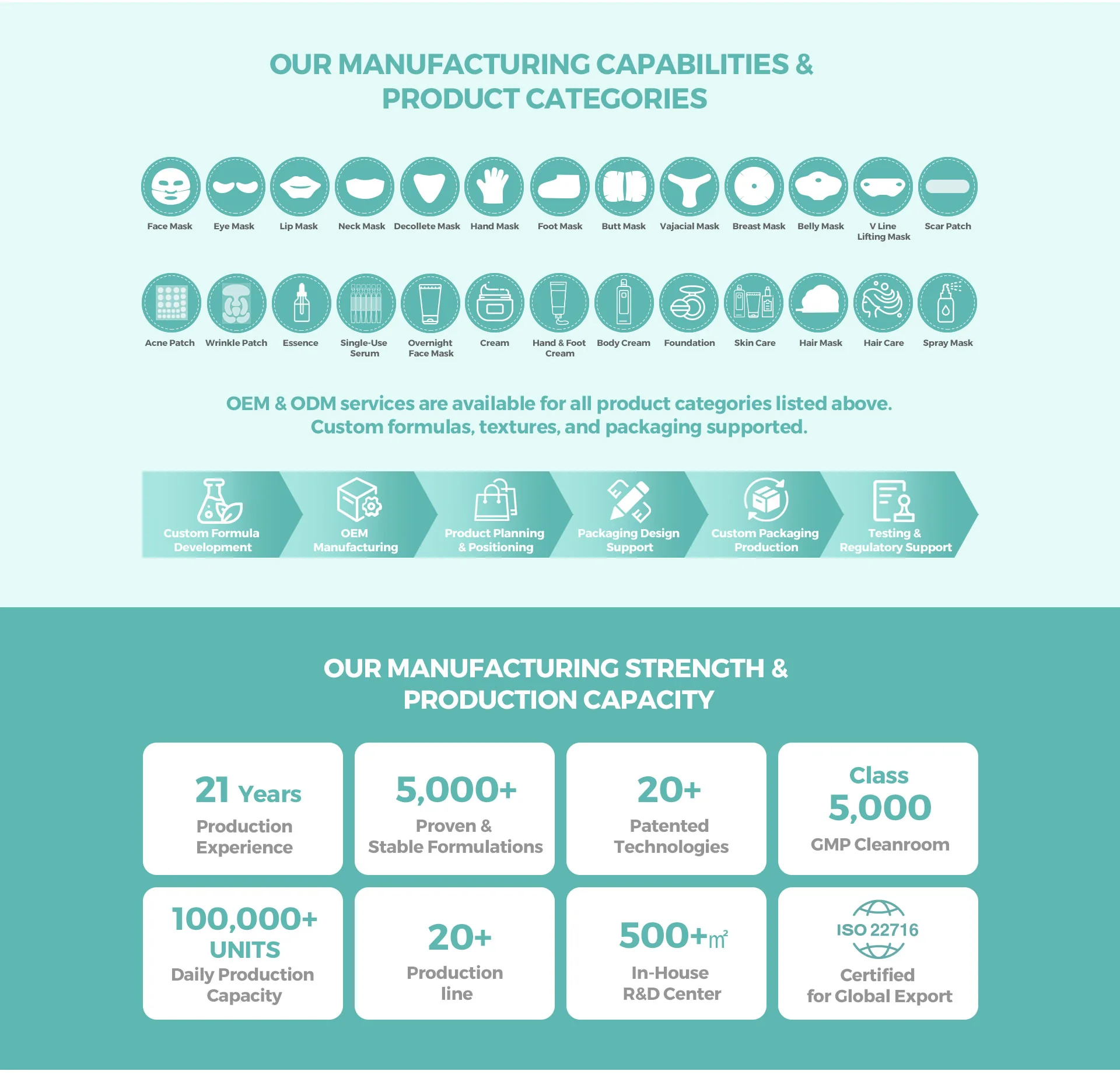
Skincraftlab is a skincare OEM/ODM contract manufacturer based in Zhongshan, Guangdong, China, operating since 2007 and supplying private-label and OEM buyers across North America, Europe, the Middle East and Southeast Asia. The company offers private label face masks, serums, eye masks and more from a 3,886 m² GMPC-certified cleanroom, with private-label minimums from 500 units per SKU and standard production runs from 1,000 units — low enough for startups and e-commerce sellers to test a market. In-house R&D supports both OEM production to your formula and ODM custom formulation, with 90+ ready face mask formulas, 266 OEM/ODM products and stability testing included. Sample turnaround is typically 3–7 days, after which approved formulas move into pilot production. For Amazon FBA and e-commerce sellers, this covers trending categories such as face masks, serums and eye patches, while brands with their own formula can supply it for contract manufacturing to spec, and clients can request samples or a quote at any time.
Frequently Asked Questions
How does hydrocolloid pimple patch active ingredient integration with salicylic acid affect my OEM formulation in China?
What is the hydrocolloid pimple patch FDA drug vs cosmetic classification for import from a China OEM?
What does a pimple patch OEM factory audit checklist under ISO 22716 and GMP actually include?
What MOQ should I expect for a private label salicylic acid pimple patch from a Chinese factory?
Can a Chinese OEM make a drug-claim pimple patch for the US market?
How long does a full hydrocolloid pimple patch OEM cycle take, from brief to US port?
Related Posts

PDRN Serum OEM China: 2% vs 0.5% Salmon DNA Specs
What 2% vs 0.5% PDRN salmon DNA really means in an OEM spec sheet, plus rolling forecast terms for 500,000 pimple patches and hydrogel under-eye patch MOQ/FOB math.

Chat Responsiveness SLA for OEM Skincare Inquiries in China
What a realistic chat responsiveness SLA looks like for OEM skincare inquiries in China — plus hydrocolloid vs hydrogel pimple patch sourcing specs and costs.

Pimple Patch OEM Line Capacity: 1M Units/Month Ramp-Up
A factory-floor ramp-up plan for taking a dedicated hydrocolloid coating line from pilot to 1 million pimple patch units per month in China, with real cycle times and QC gates.
Related Products

Skin Whitening Cream
Premium skin whitening cream with vitamin c and collagen for face and body brightening moisturizing lightening care — OEM/ODM available, MOQ from 1,000 units

Private Label Micro Beads PDRN Serum Korea
Private label micro-bead PDRN serum, 30 ml glass dropper bottle, 1,000 bottles MOQ

Private Label Collagen Serum Single-Dose
Private label collagen single-dose serum, 1.2 ml vials, 10 or 30 pcs per box, 1,000 boxes MOQ

Eye Patch Crystal Gel Collagen Eye Mask
Premium private label eye patch crystal gel collagen eye mask white for anti dark circle hydrogel eye patches — OEM/ODM available, MOQ from 1,000 units