Cosmetics GMP vs ISO 22716: Which Certification for Chinese Cosmetic Exports?
June 29, 2026
Skincraftlab
B2B Skincare Manufacturing Expert
What Is This Guide About?
Comparing Cosmetics GMP (US/FDA) vs ISO 22716 (EU) for Chinese OEM exporters. Decision framework for brand owners evaluating cosmetic factory certifications.
Category
Cosmetics GMP vs ISO 22716 which certification required Chinese cosmetic exporter
Audience
Brand owners, procurement, R&D
Updated
June 2026
For brand owners sourcing from Chinese cosmetic OEM factories, the two most commonly requested certifications are Cosmetics GMP (US FDA equivalent) and ISO 22716 (EU cosmetic GMP standard). Neither is legally mandatory for export from China, but your target market dictates which you need: ISO 22716 is required for EU CPSR compliance and recognized by ASEAN, ANVISA, and COFEPRIS; Cosmetics GMP (often certified by SGS or Bureau Veritas following the US FDA Cosmetic GMP guidelines) is preferred for US market entry and is increasingly demanded by Canadian retailers. A Chinese GMP-certified factory can hold both simultaneously — but many offer one as standard. This guide provides the exact MOQ, cost, and certification verification data you need to make a procurement decision.
Cosmetics GMP or ISO 22716: Which Certification Does a Chinese Cosmetic Exporter Need?
Choose ISO 22716 if your target market is the EU, UK, Australia, or most of Southeast Asia, and Cosmetics GMP (US FDA model) if your target is the United States or Canada — neither is legally mandatory for export from China, but your market dictates which buyers accept. ISO 22716 is mandatory for EU CPSR compliance and recognized by ASEAN, ANVISA, and COFEPRIS; Cosmetics GMP, certified by SGS or Bureau Veritas, is preferred for US entry.
Both are factory quality-management certifications costing roughly $4,000 to $8,000 per factory, with annual surveillance and 3-year recertification. Because audit overlap is about 80%, most accredited Chinese factories hold both; the second adds $2,000 to $3,000 per year. For example, Skincraftlab holds ISO 22716 and Cosmetics GMP audited by SGS and Bureau Veritas, adding 5 to 10 percent to FOB pricing. According to the market table, Mexico, Brazil, and Colombia accept ISO 22716 as the most common proof of GMP compliance.
What ISO 22716 and Cosmetics GMP Actually Cover

Both standards are cosmetic-specific Good Manufacturing Practice (GMP) frameworks. They are not product certifications — they certify the factory’s quality management system. The core overlap covers: premises, personnel hygiene, raw material traceability, production controls, deviation handling, and complaint monitoring.
| Aspect | ISO 22716:2007 | Cosmetics GMP (US FDA model) |
|---|---|---|
| Origin | EU (based on harmonized cosmetic GMP) | US (follows FDA 21 CFR 110 plus cosmetic-specific guidelines) |
| Audit body | SGS, Bureau Veritas, Intertek, TÜV, etc. | Same — any accredited third-party lab |
| Renewal | Annual surveillance + 3-year recertification | Annual surveillance + 3-year recertification |
| Recognition | Mandatory for EU – CPSR, also accepted by ASEAN, ANVISA, COFEPRIS | Required by US retailers (Walmart, Target) and Canadian health authorities |
| Typical cost per factory (China) | $4,000 – $8,000 USD (audit + certification) | $4,000 – $8,000 USD (audit + certification) |
| Deep link example | See our private label clay mask manufactured under both standards | — |
Cosmetics GMP vs ISO 22716: Which Certification Required Chinese Cosmetic Exporter?
To answer directly: you need ISO 22716 if your target market is the EU, the UK (post-Brexit accepts ISO 22716), Australia (TGA requires GMP equivalent), or most of Southeast Asia. You need Cosmetics GMP (US FDA-style) if your target is the United States or Canada.
Most accredited Chinese factories — including Skincraftlab — maintain both certifications because the audit overlap is ~80%. Paying for one additional surveillance audit adds roughly $2,000–$3,000 per year, far less than losing a buyer due to missing certification.
What About COFEPRIS, ANVISA, and INVIMA?
Mexico’s COFEPRIS, Brazil’s ANVISA, and Colombia’s INVIMA do not mandate a specific GMP certification by name. However, all three regulators require proof of GMP compliance via an audited certification. In practice, ISO 22716 is the most commonly accepted because it aligns with the EU framework that LatAm regulations reference.
| Market | Required certification | Acceptable alternatives |
|---|---|---|
| United States | Cosmetics GMP (FDA model) | ISO 22716 for top-tier retailers (Walmart may ask for Cosmetics GMP specifically) |
| European Union | ISO 22716 (mandatory for CPSR) | Cosmetics GMP alone not sufficient |
| Mexico (COFEPRIS) | ISO 22716 preferred | Cosmetics GMP sometimes accepted with additional paperwork |
| Brazil (ANVISA) | ISO 22716 (most common) | Cosmetics GMP accepted if accompanied by INMETRO certification |
| Colombia (INVIMA) | ISO 22716 or Cosmetics GMP | Both generally accepted with sanitary registration |
| Australia (TGA) | ISO 22716 or equivalent GMP | Must show GMP clearance via TGA audit |
How to Verify Certification Authenticity
Fraudulent certification documents exist in China. Never accept a PDF without independent verification. Here is how to validate:
- Check the issuing body’s logo and scope. Reputable bodies include SGS, Bureau Veritas, Intertek, TÜV Rheinland, TÜV SÜD, Eurofins, and UL. China-based bodies like CNAS are recognized domestically but may not satisfy international regulators.
- Request the certificate number and search it on the issuing body’s online portal. For example, SGS offers a public database at sgs.com/certified-suppliers.
- Confirm the factory address matches the manufacturing site you are auditing. Certificates sometimes reference a headquarters, not the factory floor.
- Check the certification scope. Does it list “cosmetics” or “cosmetic products”? Some factories hold ISO 9001 (general) but claim this covers cosmetics. It does not satisfy regulatory GMP requirements.
- Ask for the latest surveillance audit report. A live certification has an annual surveillance visit. A factory that cannot produce last year’s report may have lapsed.
Which Certification Does Skincraftlab Hold?
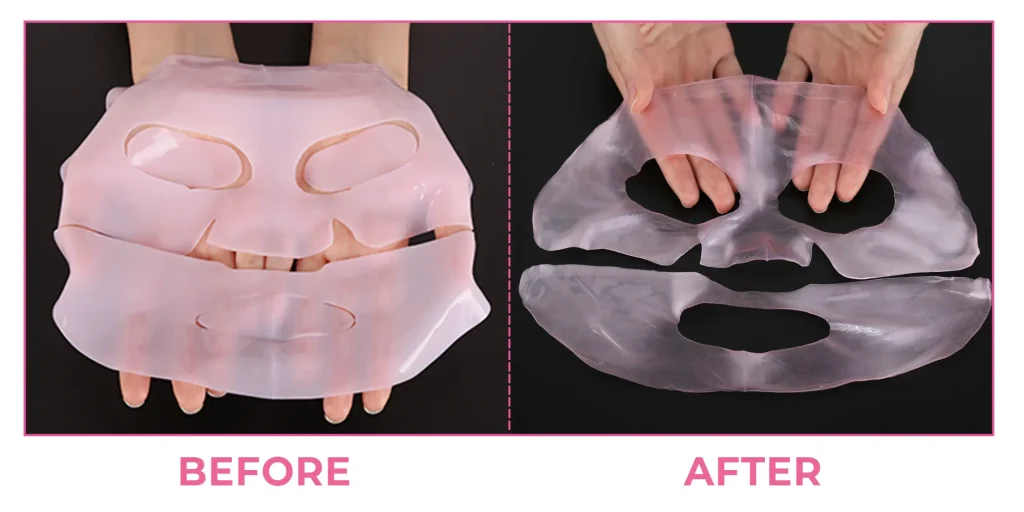
Skincraftlab is certified under both ISO 22716 and Cosmetics GMP (US FDA model), audited by SGS and Bureau Veritas. Our certifications are available for review before onboarding — no NDA required to validate. We produce products like hydrogel sheet masks and bio-collagen absorbable masks under both standards.
Cost Impact: Does Certification Affect MOQ or FOB Pricing?
Yes, but not as much as you might fear. Certification is an overhead cost amortized across orders. Here is what to expect:
| Factory tier | MOQ range | FOB price impact (vs non-certified factory) |
|---|---|---|
| ISO 22716 + Cosmetics GMP-certified | 3,000–10,000 units per SKU | +5–10% over non-certified |
| ISO 22716 only | 3,000–10,000 units per SKU | +3–7% over non-certified |
| Cosmetics GMP only | 3,000–10,000 units per SKU | +3–7% over non-certified |
| Non-certified | 1,000–5,000 units per SKU | Baseline (lowest) |
Non-certified factories may appear cheaper, but they incur hidden costs: your CPSR writer may charge double because they must audit the factory themselves, and you risk CBAM rejection or retail delisting.
Why Not Rely on ISO 9001 Alone?
ISO 9001 is a general quality management standard, not cosmetic-specific. It does not cover:
- Personnel hygiene (cosmetic-specific gowning, hair nets, sanitization)
- Raw material identity testing (spot-testing for active ingredients)
- Cosmetic-specific contamination controls (e.g., heavy metals, microbial limits)
Most international retailers and regulators require either ISO 22716 or Cosmetics GMP as a minimum. ISO 9001 is supplementary, not a substitute.
Decision Framework: Which Certification Should You Require from a Chinese Exporter?
Follow this simple three-step filter:
- Identify your target market(s). If you plan to sell in the EU + US, require both ISO 22716 and Cosmetics GMP. If only US, require Cosmetics GMP. If only EU/UK/Australia, require ISO 22716.
- Check your retailer’s supplier code of conduct. Walmart’s “GMP Certification Program” explicitly requires Cosmetics GMP. Sephora USA asks for ISO 22716 or Cosmetics GMP. European retailers (Boots, Douglas) require ISO 22716.
- Negotiate into your contract. Write into your OEM/ODM agreement: “Supplier warrants they hold valid ISO 22716 and/or Cosmetics GMP certification, and will provide copies of audit reports within 10 business days of request.”
FAQ
Q: Cosmetics GMP vs ISO 22716 which certification required Chinese cosmetic exporter for US market?
For the US market, Cosmetics GMP (US FDA model) is the standard requested by major retailers (Walmart, Target, Amazon). ISO 22716 is sometimes accepted if the factory can demonstrate GMP equivalence, but most US buyers prefer Cosmetics GMP.
Q: Can a Chinese cosmetic factory hold both ISO 22716 and Cosmetics GMP at the same time?
Yes. The standards overlap significantly (~80% common requirements). Many top-tier factories, including Skincraftlab, maintain both simultaneously because the incremental audit cost is low compared to losing a buyer.
Q: How much does ISO 22716 certification cost for a Chinese OEM factory?
A full initial audit and certification typically costs between $4,000 and $8,000 USD per factory, depending on the auditing body and factory size. Annual surveillance audits add $2,000–$4,000 per year.
Q: Does the Chinese government require GMP certification for cosmetic exports?
No. The National Medical Products Administration (NMPA) does not mandate ISO 22716 or Cosmetics GMP for export manufacturing. However, your target import country’s regulator (FDA, EU Commission, COFEPRIS, etc.) effectively requires one of these certifications to demonstrate GMP compliance.
Q: How do I verify that a Chinese factory’s Cosmetics GMP certification is real?
Ask for the certificate number and the name of the issuing body (e.g., SGS, Bureau Veritas). Search the number on the body’s public certification database. Also request the most recent surveillance audit report — a live certification always has an annual visit report.
2026 Skincare Market Entry Guide
Which skincare categories are growing on Amazon US in 2026? Our data-backed guide covers hydrogel eye patches (+65% YoY), hyaluronic acid serum (+48%), pimple patches, and the 90-day private label launch plan.
No spam, ever. Unsubscribe anytime.
What Are the Key Facts Before You Request a Quote?
Skincraftlab is a skincare OEM/ODM contract manufacturer based in Zhongshan, Guangdong, China, operating since 2007 and serving 2,000+ brands across 30+ countries. Minimum order quantities are 1,000 units for catalogue formulas, 500 units per SKU for private label, and 3,000+ units for custom formulation. Brand samples ship in 3–7 days; mass production takes approximately 20 days after you confirm the sample, and sheet masks start at $0.08–$0.35 per piece. Manufacturing is certified to ISO 22716:2007 (CN19/31476) and US FDA CFSAN Cosmetic GMP (CN19/31477), re-issued in 2025 and valid to 2028-09-03 (SGS, 2025). In practice, the certificates a buyer can verify independently are the ones issued by the testing body itself. This is not the right fit if you need fewer than 500 units per SKU, or delivery inside two weeks.
| Topic | Details |
|---|---|
| Category | Cosmetics GMP vs ISO 22716 which certification required Chinese cosmetic exporter |
| Minimum order | 1,000 units standard; 500 per SKU private label; 3,000+ custom |
| Samples & production | Brand samples 3–7 days; production approx. 20 days after confirmation |
| Last updated | June 2026 |
How Do You Apply This Guide to Your Own Project?
- 1Step 1: match the format to your unit cost — for example, sheet masks run $0.08–$0.35 per piece at 1,000 units, while serums run $1.50–$5.00 per bottle.
- 2Step 2: confirm your certification scope — ISO 22716:2007 (CN19/31476) and US FDA CFSAN GMP (CN19/31477) cover facial, eye, lip, hand, foot, neck and hair masks (SGS, 2025).
- 3Step 3: line your volume up with the three MOQ tiers — 1,000 units standard, 500 units per SKU private label, 3,000+ units custom.
- 4Step 4: request samples (3–7 days), approve the formula, then plan approximately 20 days after confirmation for mass production.
- 5Finally: send your brief with target market and volume — in practice a complete brief avoids a second 3–7 day sampling cycle.
Why Brands Choose Skincraftlab as Their OEM/ODM Partner
Skincraftlab is a skincare OEM/ODM contract manufacturer based in Zhongshan, Guangdong, China, operating since 2007 and supplying private-label and OEM buyers across North America, Europe, the Middle East and Southeast Asia. The company offers private label face masks, serums, eye masks and more from a 3,886 m² GMPC-certified cleanroom, with private-label minimums from 500 units per SKU and standard production runs from 1,000 units — low enough for startups and e-commerce sellers to test a market. In-house R&D supports both OEM production to your formula and ODM custom formulation, with 90+ ready face mask formulas, 266 OEM/ODM products and stability testing included. Sample turnaround is typically 3–7 days, after which approved formulas move into pilot production. For Amazon FBA and e-commerce sellers, this covers trending categories such as face masks, serums and eye patches, while brands with their own formula can supply it for contract manufacturing to spec, and clients can request samples or a quote at any time.
Frequently Asked Questions
Cosmetics GMP vs ISO 22716 which certification required Chinese cosmetic exporter for US market?
Can a Chinese cosmetic factory hold both ISO 22716 and Cosmetics GMP at the same time?
How much does ISO 22716 certification cost for a Chinese OEM factory?
Does the Chinese government require GMP certification for cosmetic exports?
How do I verify that a Chinese factory’s Cosmetics GMP certification is real?
Related Posts

PDRN Serum OEM China: 2% vs 0.5% Salmon DNA Specs
What 2% vs 0.5% PDRN salmon DNA really means in an OEM spec sheet, plus rolling forecast terms for 500,000 pimple patches and hydrogel under-eye patch MOQ/FOB math.

Chat Responsiveness SLA for OEM Skincare Inquiries in China
What a realistic chat responsiveness SLA looks like for OEM skincare inquiries in China — plus hydrocolloid vs hydrogel pimple patch sourcing specs and costs.

Pimple Patch OEM Line Capacity: 1M Units/Month Ramp-Up
A factory-floor ramp-up plan for taking a dedicated hydrocolloid coating line from pilot to 1 million pimple patch units per month in China, with real cycle times and QC gates.
Related Products

Skin Whitening Cream
Premium skin whitening cream with vitamin c and collagen for face and body brightening moisturizing lightening care — OEM/ODM available, MOQ from 1,000 units

Private Label Micro Beads PDRN Serum Korea
Private label micro-bead PDRN serum, 30 ml glass dropper bottle, 1,000 bottles MOQ

Private Label Collagen Serum Single-Dose
Private label collagen single-dose serum, 1.2 ml vials, 10 or 30 pcs per box, 1,000 boxes MOQ

Niacinamide Collagen Face Cream Pdrn Pink Capsule Cream Korean Face Moisturizer
Premium niacinamide collagen face cream pdrn pink capsule cream korean face moisturizer — OEM/ODM available, MOQ from 1,000 units