FDA Cosmetic Facility Registration Fee 2026 vs China MOQ 1000
July 27, 2026
Skincraftlab
B2B Skincare Manufacturing Expert
What Is This Guide About?
Breakdown of FDA cosmetic facility registration cost for 2026, paired with actual OEM production timelines for a vitamin C serum at MOQ 1000 units.
Category
FDA cosmetic facility registration fee 2026 China manufacturer
Audience
Brand owners, procurement, R&D
Updated
July 2026
If you are a brand owner planning to import a private-label vitamin C serum from a Chinese manufacturer in 2026, the FDA cosmetic facility registration fee under MoCRA for 2026 is not yet published but historically ranges between $400 and $1,000 per facility per year, and the typical OEM production timeline for a vitamin C serum at an MOQ of 1,000 units is 8–12 weeks including formulation, packaging, and quality testing. This article provides a concrete cost and timeline breakdown so you can budget accurately and align your launch calendar.
FDA Cosmetic Facility Registration Fee 2026: Current Estimates

The Food and Drug Administration (FDA) has not released the official 2026 registration fees under the Modernization of Cosmetics Regulation Act (MoCRA). Based on the 2024 fee structure and typical annual adjustments (~3-5% increase), here is the projected range:
| Fee Component | 2024 Fee | 2026 Projected Fee |
|---|---|---|
| Facility registration (per facility) | $396 | ~$420–$450 |
| Product listing (per product) | $0 (included) | $0 (included) |
| Renewal (annual) | $396 | ~$420–$450 |
Note: Foreign manufacturers must also register each facility that manufactures, packages, or distributes cosmetics for the U.S. market. This fee is per facility, not per product. If you produce your private label clay mask in the same facility as your vitamin C serum, only one registration is needed.
OEM Production Timeline: Vitamin C Serum MOQ 1000 Units from China
When you place an order for a vitamin C serum at MOQ 1000 units with a GMP-certified manufacturer like Skincraftlab (ISO 22716, Cosmetics GMP), the typical timeline is:
- Formulation & Stability Testing (2–3 weeks): Vitamin C (L-Ascorbic Acid) is notoriously unstable. Your manufacturer must formulate at pH 3.5 or lower, package in opaque airless bottles, and run accelerated stability tests (40°C / 75% RH for 4 weeks).
- Packaging Sourcing (2–4 weeks): If you choose standard stock packaging, this takes ~2 weeks. Custom printing adds 2 more weeks.
- Sample Approval (1 week): You receive 5–10 finished samples and approve.
- Mass Production & QC (2–3 weeks): Batch manufacturing, filling, labeling, and third-party microbial/pH testing.
- Shipping (3–6 weeks): Sea freight from Zhongshan (Guangdong) to a U.S. port.
Total: 8–12 weeks from signed contract to port arrival.
Cost Breakdown: FDA Registration + Production + Logistics
| Cost Item | Estimated Range (USD) |
|---|---|
| FDA facility registration (per year, 2026) | $420–$450 |
| OEM production (vitamin C serum, 1000 units, 30ml) | $3,500–$7,000 ($3.50–$7.00/unit) |
| Stability testing (if not included) | $800–$2,000 |
| Freight (sea, 1 pallet) | $400–$1,000 |
| Customs clearance & broker fee | $200–$500 |
Total first-year investment: ~$5,320–$10,950 (excluding product listing fee, which is $0 under MoCRA).
How MoCRA Affects Your Import in 2026
Under MoCRA, foreign manufacturers must:
- Register each facility with FDA (fee per facility, projected $420–$450).
- List each cosmetic product (no fee, but required).
- Name a U.S. Responsible Person (importer, distributor, or brand) who can be contacted for adverse event reporting.
Your Chinese OEM manufacturer must provide:
- GMP certificate (ISO 22716 or Cosmetics GMP)
- Certificate of Analysis (CoA) for each batch
- Full ingredient list (INCI) for FDA listing
Skincraftlab provides all these documents as part of its standard compliance package for U.S. export.
Why MOQ 1000 Makes Sense for Vitamin C Serum
Vitamin C serum is one of the most requested formulations because of its antioxidant and brightening effects. An MOQ of 1000 units is the sweet spot for new entrants:
- Low financial risk: ~$5,000 total spend.
- Enough units to test Amazon/FBA, DTC, and a few wholesale accounts.
- Fast sell-through (6–12 months) to avoid degradation.
Compare that to MOQ 5000, which triples your inventory cost and shelf-life risk with unstable actives.
FAQ
Q: What is the FDA cosmetic facility registration fee for 2026?
The official 2026 fee is not yet released, but based on the 2024 fee of $396 and a 3–5% annual adjustment, expect to pay between $420 and $450 per facility. This fee covers registration under MoCRA.
Q: How long does it take to produce a vitamin C serum at MOQ 1000 units in China?
From contract signing to arrival at a U.S. port, expect 8–12 weeks. This includes formulation, stability testing, packaging sourcing, sample approval, production, and sea freight.
Q: Does the FDA charge per product or per facility?
Per facility. One facility registration covers all cosmetics manufactured at that location. Product listing is currently free under MoCRA.
Q: Can a Chinese OEM manufacturer help with FDA registration?
No, FDA registration must be done by the brand owner or its U.S. Responsible Person. However, the manufacturer can supply all required documents (GMP certificate, CoA, INCI list) to facilitate the process.
Q: What is the minimum order quantity for a private-label vitamin C serum from a GMP factory?
MOQ typically ranges 500–3,000 units per SKU. For a vitamin C serum, Skincraftlab offers an MOQ of 1000 units for a 30ml airless pump bottle.
Q: Is vitamin C serum stable enough to ship from China to the U.S.?
Yes, if properly formulated with L-Ascorbic Acid in an opaque, airless container and kept below 25°C during transit. Stability data should be requested before production.
Related Products
2026 Skincare Market Entry Guide
Which skincare categories are growing on Amazon US in 2026? Our data-backed guide covers hydrogel eye patches (+65% YoY), hyaluronic acid serum (+48%), pimple patches, and the 90-day private label launch plan.
No spam, ever. Unsubscribe anytime.
What Are the Key Facts Before You Request a Quote?
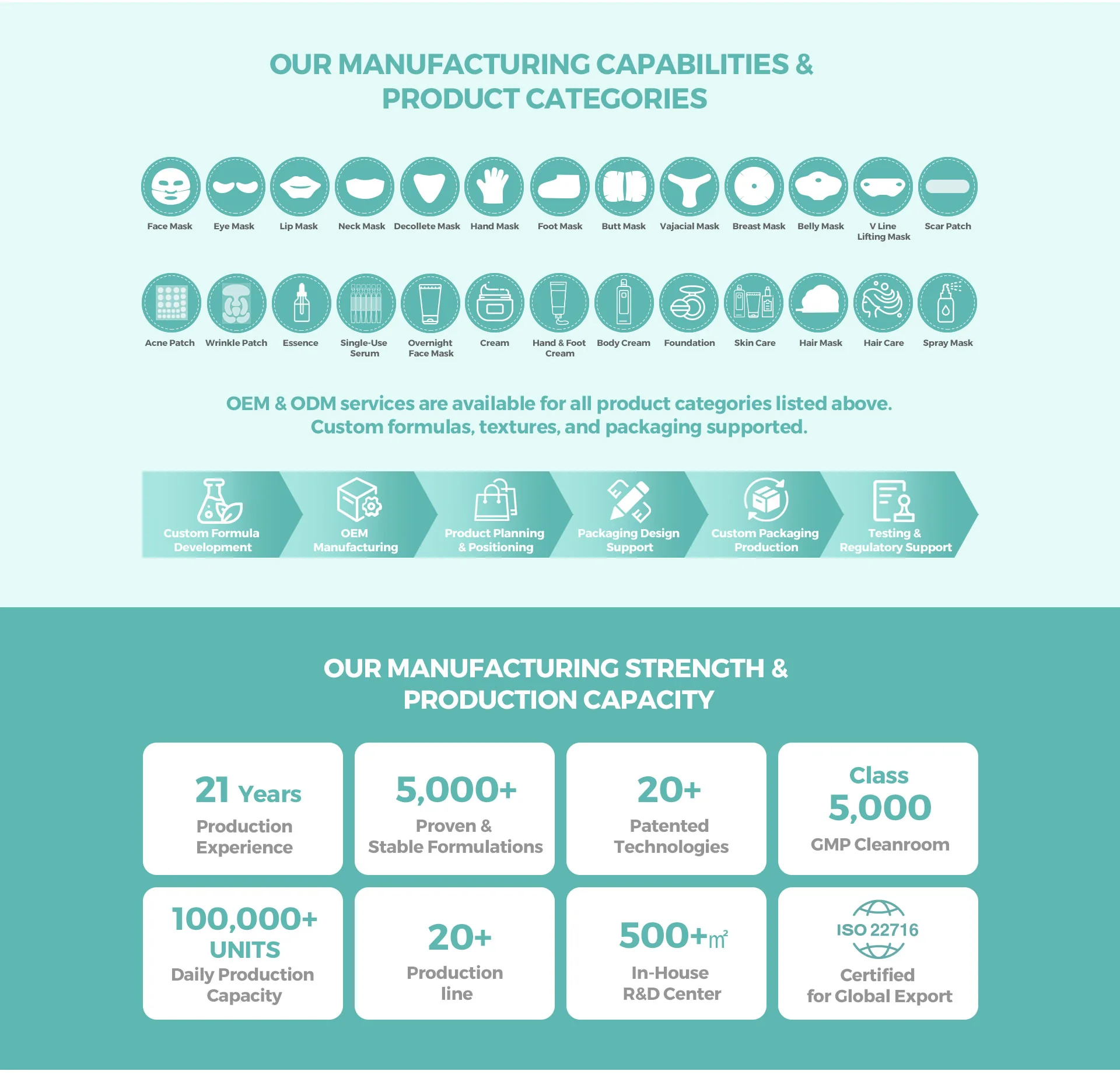
Skincraftlab is a skincare OEM/ODM contract manufacturer based in Zhongshan, Guangdong, China, operating since 2007 and serving 2,000+ brands across 30+ countries. Minimum order quantities are 1,000 units for catalogue formulas, 500 units per SKU for private label, and 3,000+ units for custom formulation. Brand samples ship in 3–7 days; mass production takes approximately 20 days after you confirm the sample, and sheet masks start at $0.08–$0.35 per piece. Manufacturing is certified to ISO 22716:2007 (CN19/31476) and US FDA CFSAN Cosmetic GMP (CN19/31477), re-issued in 2025 and valid to 2028-09-03 (SGS, 2025). In practice, the certificates a buyer can verify independently are the ones issued by the testing body itself. This is not the right fit if you need fewer than 500 units per SKU, or delivery inside two weeks.
| Topic | Details |
|---|---|
| Category | FDA cosmetic facility registration fee 2026 China manufacturer |
| Minimum order | 1,000 units standard; 500 per SKU private label; 3,000+ custom |
| Samples & production | Brand samples 3–7 days; production approx. 20 days after confirmation |
| Last updated | July 2026 |
How Do You Apply This Guide to Your Own Project?
- 1Step 1: match the format to your unit cost — for example, sheet masks run $0.08–$0.35 per piece at 1,000 units, while serums run $1.50–$5.00 per bottle.
- 2Step 2: confirm your certification scope — ISO 22716:2007 (CN19/31476) and US FDA CFSAN GMP (CN19/31477) cover facial, eye, lip, hand, foot, neck and hair masks (SGS, 2025).
- 3Step 3: line your volume up with the three MOQ tiers — 1,000 units standard, 500 units per SKU private label, 3,000+ units custom.
- 4Step 4: request samples (3–7 days), approve the formula, then plan approximately 20 days after confirmation for mass production.
- 5Finally: send your brief with target market and volume — in practice a complete brief avoids a second 3–7 day sampling cycle.
Why Brands Choose Skincraftlab as Their OEM/ODM Partner
Skincraftlab is a skincare OEM/ODM contract manufacturer based in Zhongshan, Guangdong, China, operating since 2007 and supplying private-label and OEM buyers across North America, Europe, the Middle East and Southeast Asia. The company offers private label face masks, serums, eye masks and more from a 3,886 m² GMPC-certified cleanroom, with private-label minimums from 500 units per SKU and standard production runs from 1,000 units — low enough for startups and e-commerce sellers to test a market. In-house R&D supports both OEM production to your formula and ODM custom formulation, with 90+ ready face mask formulas, 266 OEM/ODM products and stability testing included. Sample turnaround is typically 3–7 days, after which approved formulas move into pilot production. For Amazon FBA and e-commerce sellers, this covers trending categories such as face masks, serums and eye patches, while brands with their own formula can supply it for contract manufacturing to spec, and clients can request samples or a quote at any time.
Frequently Asked Questions
What is the FDA cosmetic facility registration fee for 2026?
How long does it take to produce a vitamin C serum at MOQ 1000 units in China?
Does the FDA charge per product or per facility?
Can a Chinese OEM manufacturer help with FDA registration?
What is the minimum order quantity for a private-label vitamin C serum from a GMP factory?
Is vitamin C serum stable enough to ship from China to the U.S.?
Related Posts

PDRN Serum OEM China: 2% vs 0.5% Salmon DNA Specs
What 2% vs 0.5% PDRN salmon DNA really means in an OEM spec sheet, plus rolling forecast terms for 500,000 pimple patches and hydrogel under-eye patch MOQ/FOB math.

Chat Responsiveness SLA for OEM Skincare Inquiries in China
What a realistic chat responsiveness SLA looks like for OEM skincare inquiries in China — plus hydrocolloid vs hydrogel pimple patch sourcing specs and costs.

Pimple Patch OEM Line Capacity: 1M Units/Month Ramp-Up
A factory-floor ramp-up plan for taking a dedicated hydrocolloid coating line from pilot to 1 million pimple patch units per month in China, with real cycle times and QC gates.