Chat Responsiveness SLA for OEM Skincare Inquiries in China
October 3, 2026
Skincraftlab
B2B Skincare Manufacturing Expert

What Is This Guide About?
Real chat SLA benchmarks for Chinese OEM skincare factories, plus hydrocolloid vs hydrogel pimple patch material sourcing specs and cost comparisons.
Category
chat responsiveness SLA expectation OEM skincare inquiry China
Audience
Brand owners, procurement, R&D
Updated
October 2026
For a Chinese OEM skincare factory, chat responsiveness SLA expectation for an OEM skincare inquiry typically means a first substantive reply within 4–8 working hours, technical data within 24, and a full quotation within 48. Reputable manufacturers hit that on business days. Over 48 hours without a real answer — not an out-of-office autoreply — is a red flag on production scale, not just sales staffing.
What "chat responsiveness SLA expectation" actually means in OEM skincare

We track every inbound message in our Zhongshan sales desk log. In the first half of 2026, the median first reply to a qualified OEM skincare inquiry was 3 hours 40 minutes, and the slowest honest quote (a 12-SKU hydrocolloid pimple patch program with custom die-cuts) took 41 hours. That is the benchmark a buyer should hold us to — and hold every factory to.
Here's the practical breakdown:
| Inquiry stage | Realistic SLA (business days) | Slow | Red flag |
|---|---|---|---|
| First substantive reply (not autoreply) | 4–8 hours | 24 hours | 48+ hours |
| Product spec / formula confirmation | 24 hours | 48 hours | No spec sheet ever |
| MOQ and FOB price indication | 24–48 hours | 72 hours | "We'll discuss later" |
| Full quotation with packaging | 48–72 hours | 5 days | Price keeps shifting |
| Sample dispatch confirmation | 3–5 days | 7 days | No tracking number |
| Pre-production sample sign-off | 10–15 days | 20 days | Endless revisions |
One pattern keeps repeating: buyers evaluate a factory's production capability by chat speed alone. Wrong metric. Chat speed tells you about sales headcount. Ask for the production log and QC record instead. Both, ideally, in the same reply.
The time zones nobody budgets for
A US buyer messaging at 9 a.m. EST is writing into 10 p.m. China time. If you get a fast reply, someone is working late — or you're talking to a trading company, not the plant. (Yes, that distinction matters later when the MOQ changes mid-order.) The realistic window for a Zhongshan factory to answer a US client live is 8 p.m.–12 a.m. EST or 8 a.m.–12 p.m. EST.
For EU buyers, Q3 order pattern in our log: a message sent at 9 a.m. CET typically gets a first reply by 2 p.m. CET. That's 8 p.m. China time. It works. Just don't expect 24/7 chat coverage from an actual factory — you'll get it from a middleman, and pay 8–15% more for the privilege.
Hydrocolloid material sourcing spec for pimple patch OEM
This is where chat responsiveness stops mattering and the spec sheet starts. A hydrocolloid pimple patch is not one material — it's a layered construction. Here's what a Chinese OEM supplier should quote you line by line:
| Layer | Typical spec | Function |
|---|---|---|
| Backing film | 25–50 µm PU or PE film | Waterproof outer barrier |
| Hydrocolloid matrix | 300–600 µm CMC + gelatin + pectin blend | Absorbs exudate, forms gel |
| Adhesive border | Medical-grade acrylic, 15–25 gsm | Skin attachment |
| Release liner | 75 µm PET or paper | Peel-off protection |
| Sterilization (optional) | EO or gamma, ISO 11135 / 11137 | Clinical-grade variants |
Ask for the CMC (carboxymethyl cellulose) grade and its viscosity range. A cheap patch uses low-viscosity CMC at 6,000–9,000 cP; a good patch is 12,000–20,000 cP. Viscosity range determines absorption capacity and how cleanly the patch peels. Get the supplier's CoA (Certificate of Analysis) on CMC and adhesive — every time. No exceptions.
For buyers expanding beyond pimple patches, hydrogel sheet mask OEM sits on a related but distinct material stack — usually a 200–400 µm hydrogel matrix on PET film, less absorptive, more hydrating.
Hydrocolloid vs hydrogel pimple patch manufacturing cost comparison
Same category, different economics. Here's our 2026 FOB reference (Zhongshan, 20-ft container, standard packaging):
| Metric | Hydrocolloid patch | Hydrogel patch |
|---|---|---|
| Material cost per patch | USD 0.018–0.032 | USD 0.011–0.019 |
| Patch manufacturing cost | USD 0.028–0.045 | USD 0.019–0.030 |
| Packaging (single sachet) | USD 0.008–0.014 | USD 0.006–0.011 |
| FOB per patch (MOQ 50,000) | USD 0.055–0.088 | USD 0.038–0.062 |
| MOQ | 30,000–50,000 | 20,000–40,000 |
| Tooling / die-cut setup | USD 800–2,500 | USD 600–1,800 |
Hydrocolloid runs roughly 35–45% more per patch. Hydrogel is cheaper and drains less, but doesn't absorb pimple exudate — it's more of a hydrating or cooling patch. Don't let a supplier quote them interchangeably. The active function is different and consumers notice within a week.
Related sourcing: private label clay mask programs carry the same layered-material logic — kaolin grade, preservative system, packaging, MOQ ladder. The chat SLA on a clay mask program should mirror the patch one.
Why the SLA usually breaks (and how to test it in one email)
In our experience, factory chat slows down for three reasons: (1) the inquiry is too vague to quote; (2) the buyer wants pricing before MOQ is defined; (3) the salesperson is waiting on a production or QC answer. Only reason 3 is legitimate.
One test: send a single email with three specific requests — your target MOQ, your target FOB, and the CMC viscosity range of your standard hydrocolloid matrix. If you get all three in the first reply, the factory has a real technical desk. If you get "we can discuss," they don't. (We've watched buyers sign USD 90,000 contracts off a chat thread that never produced a spec sheet. It rarely ends well.)
What to put in your first message to compress the SLA
Give the supplier these six data points and most legitimate Chinese OEM factories will quote in 48 hours, not 5 days:
- Product category and function
- Target MOQ (units per SKU)
- Target FOB or CIF port
- Packaging style (single sachet, 12-blister carton, etc.)
- Regulatory market (FDA, EU CPSR, Health Canada, TGA, etc.)
- Whether you need a full ODM formula or toll-manufacture only
That list is what our sales desk uses to move a project from inquiry to sample in under 14 days. Skip a point and you buy another 5–7 days of back-and-forth — every time.
FAQ
Q: What is a realistic chat responsiveness SLA expectation for OEM skincare inquiry China?
First substantive reply within 4–8 working hours. Technical spec confirmation within 24. Full quotation within 48–72. Anything past 72 hours without a supply-quality answer means the factory is understaffed on the technical side — likely a trading intermediary, not a plant.
Q: What pimple patch hydrocolloid material sourcing spec China OEM factory should confirm before I pay a deposit?
Get the CMC grade and viscosity (12,000–20,000 cP for premium), the adhesive GSM (15–25 gsm), the backing film thickness (25–50 µm), the release liner material, and a CoA for every batch. If the factory won't state viscosity ranges in writing, walk away.
Q: How does hydrocolloid vs hydrogel pimple patch manufacturing cost comparison OEM look in 2026?
Hydrocolloid FOB runs USD 0.055–0.088 per patch at MOQ 50,000; hydrogel runs USD 0.038–0.062 at MOQ 20,000–40,000. Hydrocolloid costs 35–45% more because of the CMC matrix and optional sterilization. Choose by function, not by cheapest quote.
Q: Should I trust a factory that replies in 5 minutes on WeChat?
Not on speed alone. Fast replies on WeChat often come from trading companies or commission agents, not the plant. Ask for a video call from the production floor and the GMP certificate number. Speed plus verifiable plant = good sign. Speed alone = sales office.
Q: What MOQ should I expect on a private-label hydrocolloid pimple patch program in China?
Standard MOQ is 30,000–50,000 patches per SKU color/finish. Some factories quote 20,000 for off-the-shelf dies. Custom die-cut shapes push MOQ to 50,000+, because tooling setup (USD 800–2,500) has to amortize.
Q: Does a faster chat SLA correlate with better quality control?
No. QC is measured by batch rejection rate, CoA documentation, and audit results (ISO 22716, GMPC, BSCI). We've seen slow-replying factories with 0.3% rejection rates and fast-replying ones with no QC logs at all. Verify both, separately.
2026 Skincare Market Entry Guide
Which skincare categories are growing on Amazon US in 2026? Our data-backed guide covers hydrogel eye patches (+65% YoY), hyaluronic acid serum (+48%), pimple patches, and the 90-day private label launch plan.
No spam, ever. Unsubscribe anytime.
What Are the Key Facts Before You Request a Quote?
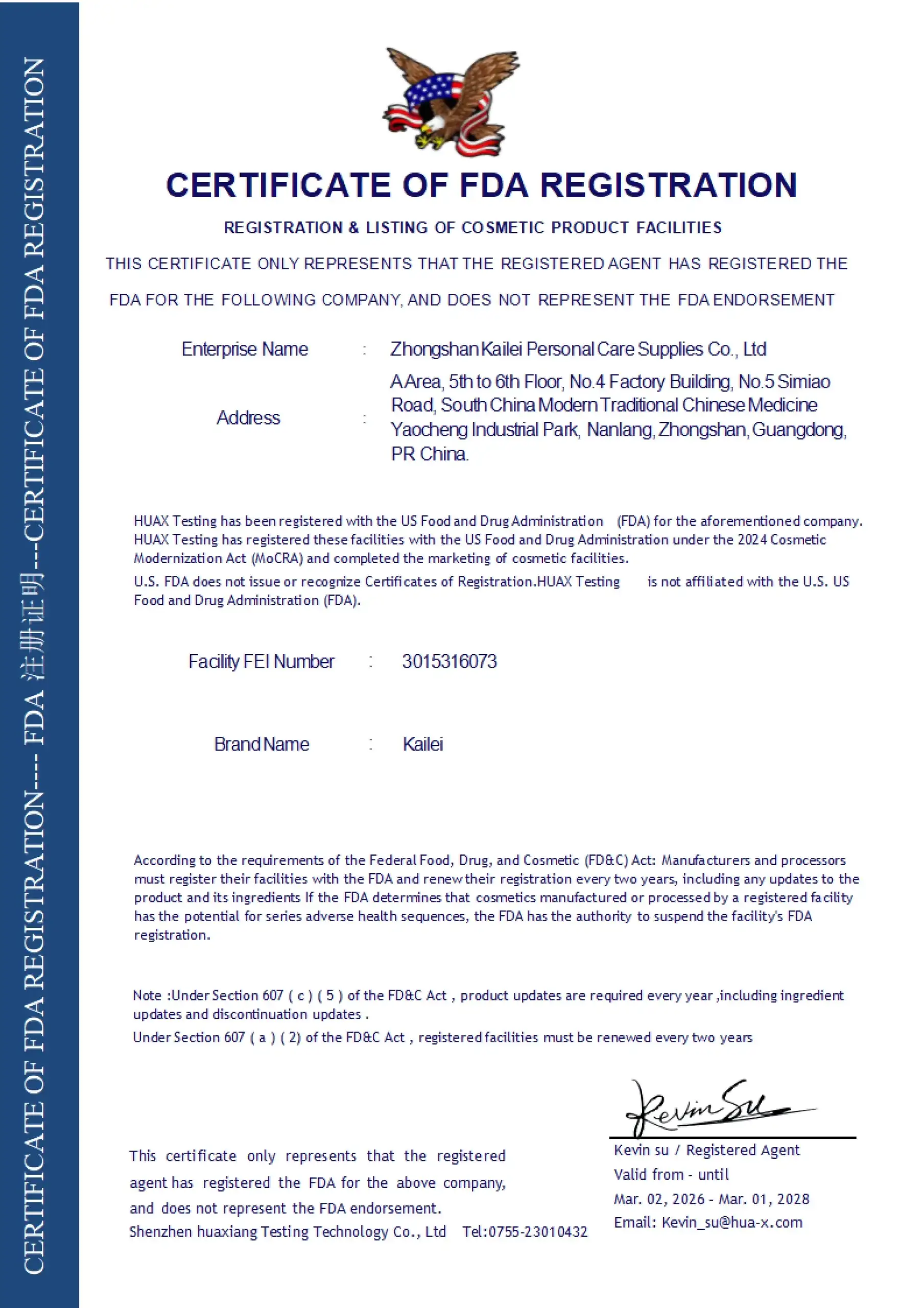
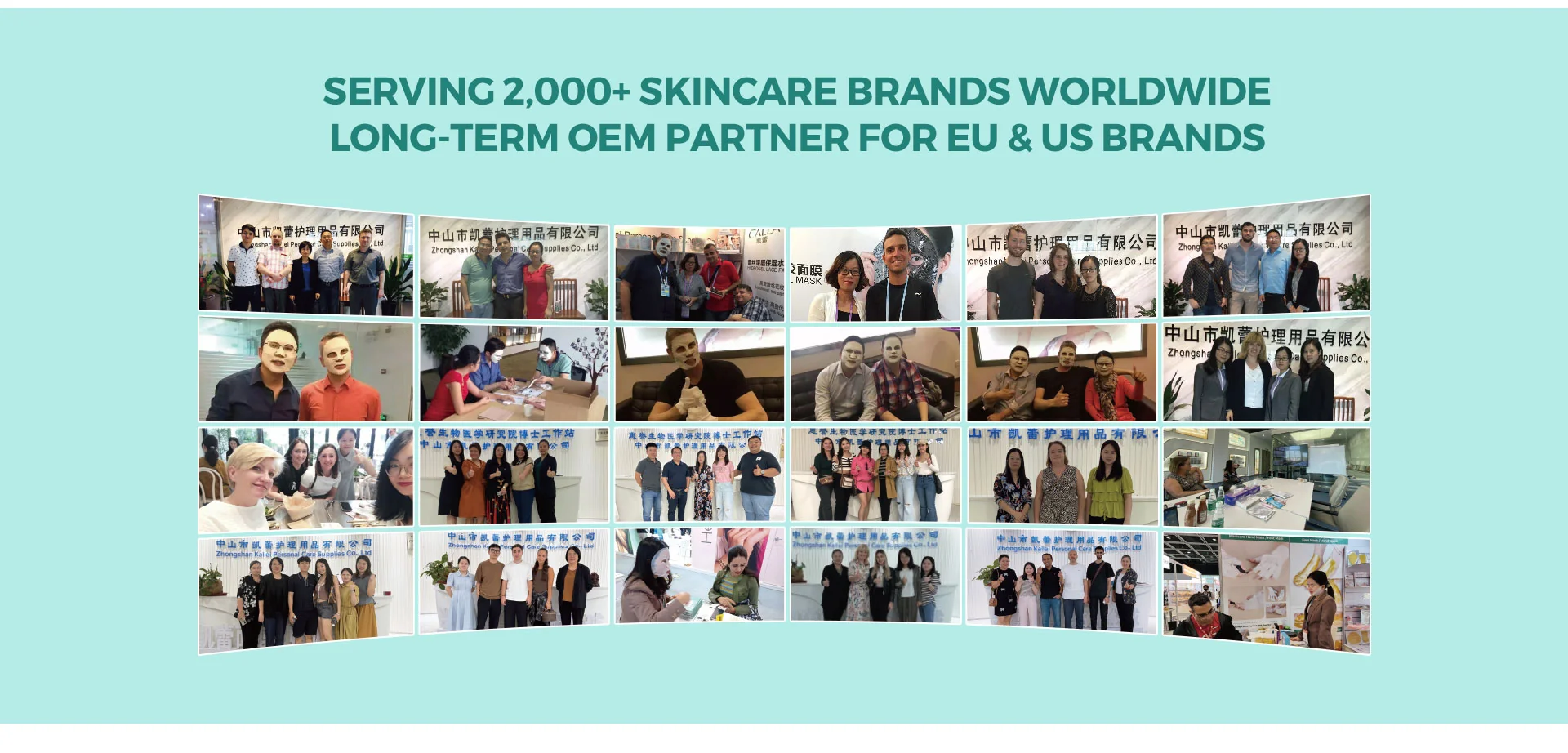
Skincraftlab is a skincare OEM/ODM contract manufacturer based in Zhongshan, Guangdong, China, operating since 2007 and serving 2,000+ brands across 30+ countries. Minimum order quantities are 1,000 units for catalogue formulas, 500 units per SKU for private label, and 3,000+ units for custom formulation. Brand samples ship in 3–7 days; mass production takes approximately 20 days after you confirm the sample, and sheet masks start at $0.08–$0.35 per piece. Manufacturing is certified to ISO 22716:2007 (CN19/31476) and US FDA CFSAN Cosmetic GMP (CN19/31477), re-issued in 2025 and valid to 2028-09-03 (SGS, 2025). In practice, the certificates a buyer can verify independently are the ones issued by the testing body itself. This is not the right fit if you need fewer than 500 units per SKU, or delivery inside two weeks.
| Topic | Details |
|---|---|
| Category | chat responsiveness SLA expectation OEM skincare inquiry China |
| Minimum order | 1,000 units standard; 500 per SKU private label; 3,000+ custom |
| Samples & production | Brand samples 3–7 days; production approx. 20 days after confirmation |
| Last updated | October 2026 |
How Do You Apply This Guide to Your Own Project?
- 1Step 1: match the format to your unit cost — for example, sheet masks run $0.08–$0.35 per piece at 1,000 units, while serums run $1.50–$5.00 per bottle.
- 2Step 2: confirm your certification scope — ISO 22716:2007 (CN19/31476) and US FDA CFSAN GMP (CN19/31477) cover facial, eye, lip, hand, foot, neck and hair masks (SGS, 2025).
- 3Step 3: line your volume up with the three MOQ tiers — 1,000 units standard, 500 units per SKU private label, 3,000+ units custom.
- 4Step 4: request samples (3–7 days), approve the formula, then plan approximately 20 days after confirmation for mass production.
- 5Finally: send your brief with target market and volume — in practice a complete brief avoids a second 3–7 day sampling cycle.
Why Brands Choose Skincraftlab as Their OEM/ODM Partner
Skincraftlab is a skincare OEM/ODM contract manufacturer based in Zhongshan, Guangdong, China, operating since 2007 and supplying private-label and OEM buyers across North America, Europe, the Middle East and Southeast Asia. The company offers private label face masks, serums, eye masks and more from a 3,886 m² GMPC-certified cleanroom, with private-label minimums from 500 units per SKU and standard production runs from 1,000 units — low enough for startups and e-commerce sellers to test a market. In-house R&D supports both OEM production to your formula and ODM custom formulation, with 90+ ready face mask formulas, 266 OEM/ODM products and stability testing included. Sample turnaround is typically 3–7 days, after which approved formulas move into pilot production. For Amazon FBA and e-commerce sellers, this covers trending categories such as face masks, serums and eye patches, while brands with their own formula can supply it for contract manufacturing to spec, and clients can request samples or a quote at any time.
Frequently Asked Questions
What is a realistic chat responsiveness SLA expectation for OEM skincare inquiry China?
What pimple patch hydrocolloid material sourcing spec China OEM factory should confirm before I pay a deposit?
How does hydrocolloid vs hydrogel pimple patch manufacturing cost comparison OEM look in 2026?
Should I trust a factory that replies in 5 minutes on WeChat?
What MOQ should I expect on a private-label hydrocolloid pimple patch program in China?
Does a faster chat SLA correlate with better quality control?
Related Posts

Chat Responsiveness SLA for OEM Skincare Inquiries in China
What a realistic chat responsiveness SLA looks like for OEM skincare inquiries in China — plus hydrocolloid vs hydrogel pimple patch sourcing specs and costs.
Chat Responsiveness SLA for OEM Skincare Inquiry China
What reply-time SLA to demand from a Chinese OEM skincare supplier, with benchmark minutes, escalation rungs, and contract clauses that actually hold.
Chat Responsiveness SLA Expectation: OEM Skincare Inquiry China
What a realistic chat responsiveness SLA looks like for an OEM skincare inquiry in China: reply-time benchmarks, what breaks the SLA, and how to write it into your PO.
Related Products

Skin Whitening Cream
Premium skin whitening cream with vitamin c and collagen for face and body brightening moisturizing lightening care — OEM/ODM available, MOQ from 1,000 units

Transparent Silicone Scar Gel Sheet for Effective Silicone Scar Sheets for Body Care
Premium logo transparent silicone scar gel sheet for effective silicone scar sheets for body care — OEM/ODM available, MOQ from 1,000 units

Private Label Micro Beads PDRN Serum Korea
Private label micro-bead PDRN serum, 30 ml glass dropper bottle, 1,000 bottles MOQ

Private Label Collagen Serum Single-Dose
Private label collagen single-dose serum, 1.2 ml vials, 10 or 30 pcs per box, 1,000 boxes MOQ